Centre considering to lift restrictions on airport ownership
INFRASTRUCTURE
23 JULY 2026
- The Centre is considering removing restrictions on cross-ownership between airport operators and airlines, a move that could allow airport companies to own airlines and airline groups to acquire stakes in airports, according to people familiar with the matter.
- The Ministry of Civil Aviation is preparing a concept note for consultations with NITI Aayog and other government ministries on the proposed changes.
- The proposal comes amid Air India’s interest in expanding into the airport business, one person aware of discussions added but senior Air India sources denied it.
- Air India is jointly owned by Tata Sons, which holds a 74.9% stake, and Singapore Airlines, which owns the remaining 25.1%.
- Some existing airport concession agreements impose limits on airline ownership. For instance, the concession agreements for the Noida International Airport and Navi Mumbai International Airport projects provide that no scheduled airline, cargo airline or their associates may hold more than 26% of the subscribed and paid-up equity of the concessionaire.
- The ownership restrictions are even tighter for Delhi and Mumbai airports. Under the original privatisation framework, the aggregate equity held by all Indian scheduled airlines was capped at 10%, while foreign airlines were not permitted to hold any equity in the airport operating companies.
- These restrictions also operate in reverse, effectively preventing airport operators from owning or controlling airlines.
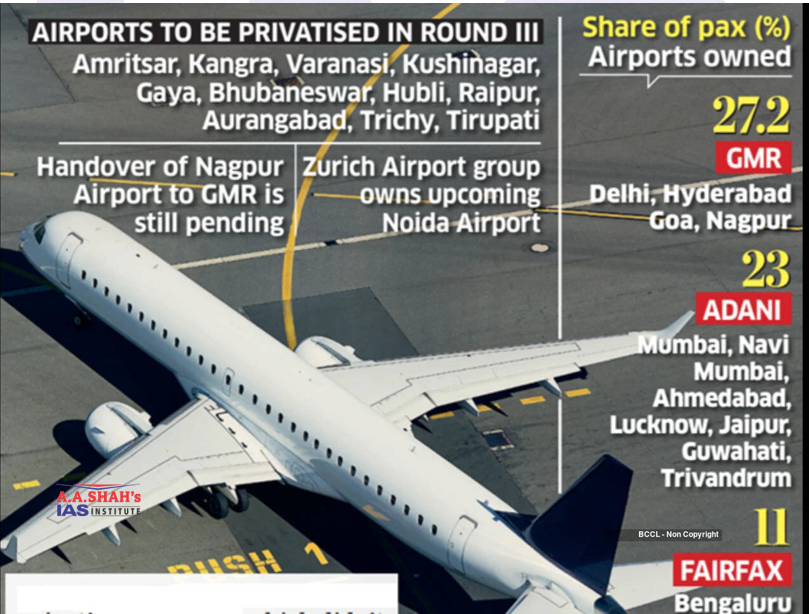
- The Adani Group, which operates eight airports and has businesses spanning ports, power and renewable energy, has so far maintained thatit has no interest in entering the airline business amid growing discussions around the dominance of Air India and IndiGo, which have a duopoly between them.
- The discussions come at a time when the Ministry of Civil Aviation has submitted a proposal to the Public Private Partnership Appraisal Committee (PPPAC) for the third round of airport privatisation of 11 airports, which too will come before the Cabinet for its nod.
- In 2019, the Tata Group, through a consortium with Singapore’s sovereign wealth fund GIC, had proposed to acquire a 55.2% stake in GMR Airports, but the deal did not materialise due to a conflict of interest issue involving Tatas’ stake in Vistara and AirAsia India.
- Since then, Vistara has been merged into Air India, while AirAsia India has been integrated into Air India Express, both of which are part of the Tata Group’s airline portfolio.
Privatization of Airports in India
- India has not fully privatized its airports.
- Instead, many airports are operated under the Public-Private Partnership (PPP) model, where the airport remains publicly owned (through the Airports Authority of India, AAI) but its operation, management, and development are leased to private companies for a fixed period.
Timeline
| Year | Development |
| 2006 | Delhi and Mumbai airports leased under PPP. |
| 2008 | Greenfield PPP airports at Bengaluru and Hyderabad became operational. |
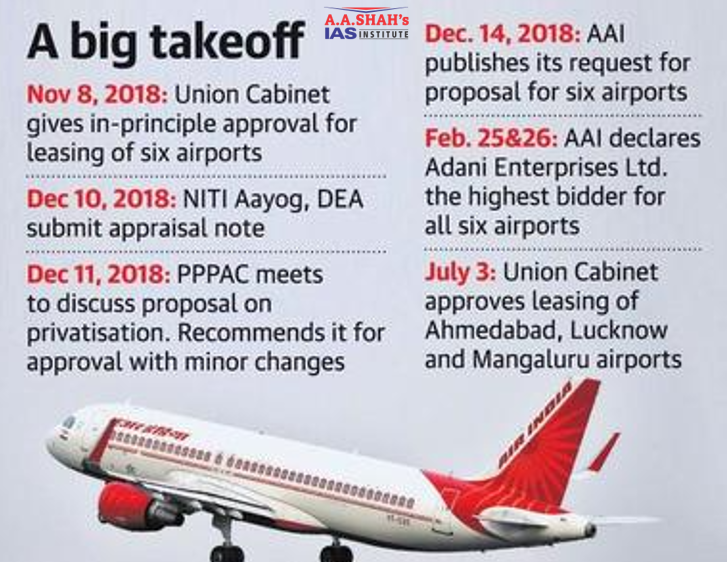
| 2019 | Cabinet approved leasing of six more AAI airports under PPP. |
| 2021 | Thiruvananthapuram airport handed over to the concessionaire. |
Airports Currently Under PPP (2026)
| Airport | Operator |
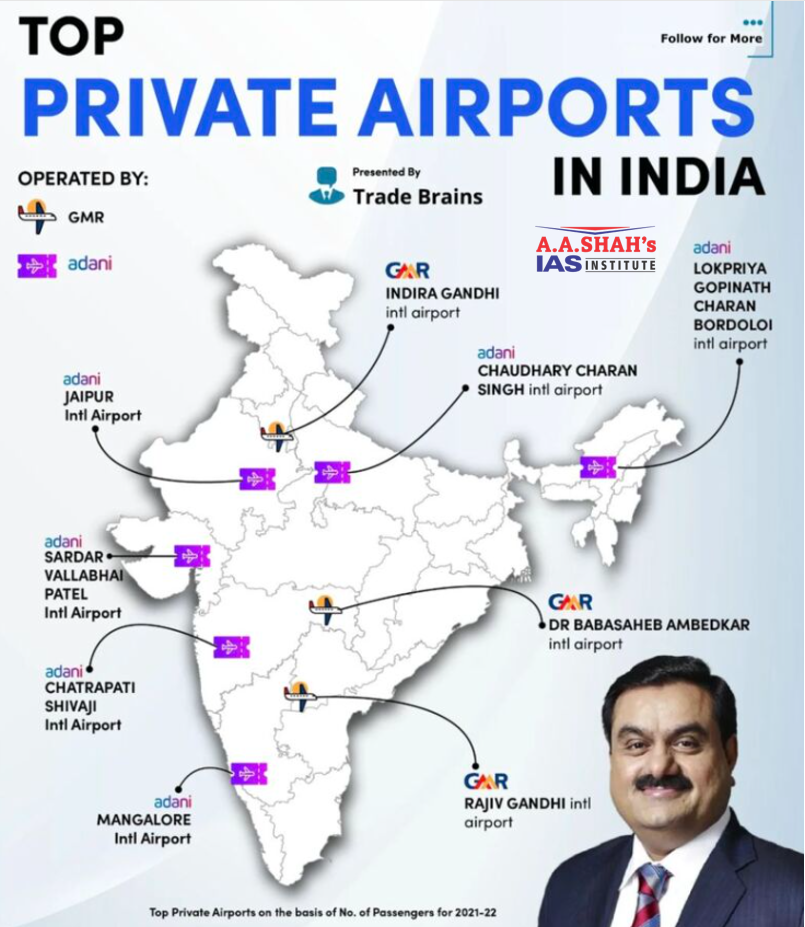
| Delhi | GMR Group-led consortium |
| Mumbai | Adani Airport Holdings |
| Bengaluru | Bangalore International Airport Ltd. |
| Hyderabad | GMR Hyderabad International Airport Ltd. |
| Cochin | Cochin International Airport Ltd. (PPP model with public/private participation) |
| Ahmedabad | Adani Airport Holdings |
| Lucknow | Adani Airport Holdings |
| Mangaluru | Adani Airport Holdings |
| Jaipur | Adani Airport Holdings |
| Guwahati | Adani Airport Holdings |
| Thiruvananthapuram | Adani Airport Holdings |
Note: The government officially refers to 8 AAI airports leased under PPP (Delhi, Mumbai, Ahmedabad, Lucknow, Mangaluru, Jaipur, Guwahati, Thiruvananthapuram). Bengaluru, Hyderabad, and Cochin are PPP airports developed through different concession arrangements.
Next Phase of Privatization in 2026
- The Government has identified 11 airports for the next round of PPP:
- Major airports: Amritsar, Varanasi, Bhubaneswar, Raipur, Tiruchirappalli (Trichy)
- These are paired with six smaller airports for bundled bidding.
Advantages
- Modern world-class terminals.
- Better passenger amenities and technology.
- Increased private investment.
- Higher concession revenue for AAI.
- AAI can focus on developing regional airports under schemes like UDAN.
Concerns
- Risk of concentration of airport operations among a few private operators.
- Potential increase in user charges if not effectively regulated.
- Concerns over reduced public control of strategic infrastructure.
- Need for strong regulatory oversight by bodies such as AERA and DGCA.