CJI’s role in CEC, EC appointments was temporary, pending new law: SC
POLITY – ELECTIONS
7 MAY 2026
- The Supreme Court said the Chief Justice of India’s involvement in the appointment of the Chief Election Commissioner (CEC) and Election Commissioners (ECs) was only meant to last until Parliament came up with a law.
- The court’s observation was in response to multiple petitions challenging the Chief Election Commissioner and other Election Commissioners (Appointment, Conditions of Service, and Term of Office) Act of 2023.
- The petitioners, who include the Association for Democratic Reforms and activist Jaya Thakur, said the 2023 law clothed the political executive of the day with a dominant, if not “exclusive”, control over the appointment of the CEC and ECs.
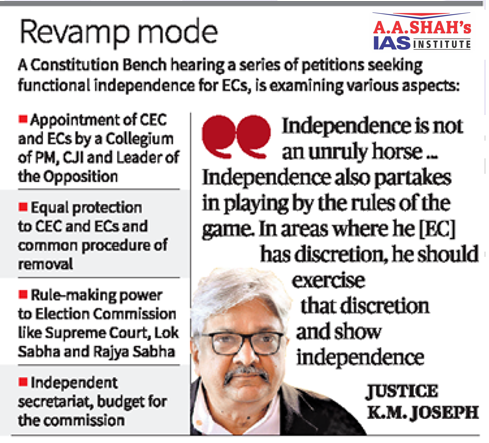
- The law was introduced in December 2023, ostensibly to countermand a Constitution Bench judgment in March 2023 (Anoop Baranwal v. Union of India). This judgment had declared that CEC and EC appointments should be made on the recommendation of a committee of the Prime Minister, the Leader of the Opposition of the Lok Sabha (LoP) or the leader of the largest Opposition party in the Lok Sabha, and the Chief Justice of India (CJI).
- The court had ordered that its judgment would remain operative till “Parliament makes a law in consonance with Article 324(2) of the Constitution”.
- Consequently, the government brought the 2023 Act, replacing the CJI with a Union Cabinet Minister in the committee.
- The current CEC, Gyanesh Kumar, was the first to be appointed to the office under the new law.
- Senior advocate Vijay Hansaria, appearing for the petitioners, said the Constitution framers and the Supreme Court itself had never intended the CEC to be the “Prime Minister’s baby or the Prime Minister’s man”.
- Prior to the judgment, the CEC and ECs were appointed by the President on the advice of the Prime Minister.
- The judgment had brought the appointment process on par with that of the CBI Director.