Deaths in Brazil raise concerns about India’s dengue vaccine, DengiAll
SOCIAL – HEALTH
15 JUNE 2026
- The recent deaths of two people in Brazil during its dengue vaccination campaign, leading to the shot’s suspension on June 8, 2026 is a crucial wake-up call for India.
- Of 42 vaccine recipients who displayed serious side-effects, two people died and one had to receive intensive care.
- These side-effects included severe abdominal pain, persistent vomiting, and bleeding, none of which the phase 3 clinical trials revealed.
- Brazilian authorities have stressed that the 42 cases of severe adverse events out of half-a-million vaccinated represent only 0.008%.
- The dengue vaccine in Brazil, Butantan-DV, is pretty similar, if not identical, to India’s upcoming dengue vaccine, DengiAll.
- Both vaccines were several years in the making.
- Both have live but weakened (attenuated) versions of the dengue viruses (DENVs).
- And both vaccines are said to be tetravalent because each vaccine is a physical mixture of four live, weakened DENV serotypes: DENV-1, -2, -3 and -4.
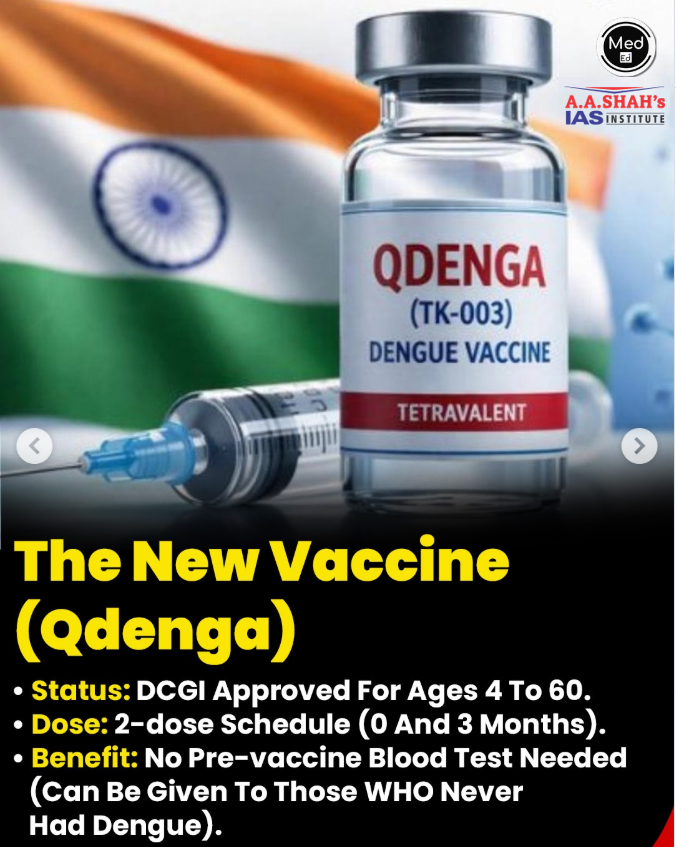
- Another tetravalent dengue vaccine, Qdenga, marketed by Japan-based Takeda has its India approval awaited.
DENV serotypes
- Dengue viruses (DENVs) have four serotypes: DENV-1, -2, -3 and -4.
- All four serotypes are known to be prevalent in Brazil and India.
- Each DENV serotype has an outer shell adorned with specialised envelope proteins, called E proteins — akin to the spike protein of coronaviruses.
- Even though the four DENV serotypes are very similar, their E proteins are different enough to warrant immunisation against each of the four serotypes.
DENV Antibodies
- When weakened DENV is used in a vaccine, it will prompt two broad types of antibodies: type-specific antibodies and cross-reactive antibodies.
- Type-specific antibodies are often made in small amounts and recognise only one particular serotype (based on its E proteins) and excel at blocking infections by that serotype alone.
- On the other hand, the cross-reactive antibodies are made usually in large amounts and can recognise any of the four serotypes and block an infection — provided they are present at adequate levels.
Antibody-Dependent Enhancement (ADE).
- When the cross-reactive antibodies levels drop, they don’t just fail to block a new DENV infection: they enhance it, leading to a severe and potentially fatal form of dengue. This phenomenon is called antibody-dependent enhancement (ADE).
- The risk of ADE during dengue vaccination is considered a serious adverse event.
- If untreated, it can lead to death.
Phase 3 Clinical Trials of DengiAll
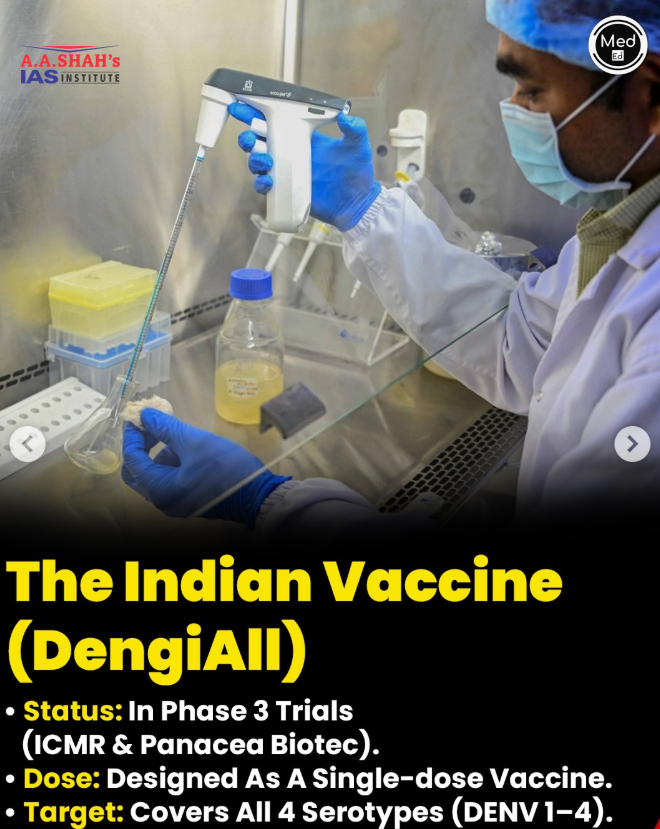
- DengiAll is a single-dose dengue vaccine developed by Panacea Biotec in collaboration with the Indian Council of Medical Research (ICMR)
- Phase 3 clinical trials completed its enrollment target of 10,335 healthy volunteers in January 2026.
- The trial began in August 2024; its participants will be followed for two years post-vaccination. Once all the data have been analysed, the company will approach the drug regulator for market approval.
Qdenga Approval in India
- India has officially approved Takeda’s Qdenga (TAK-003), making it the country’s first clearance for a dengue vaccine.
- Developed by the Japanese pharmaceutical company Takeda in partnership with Hyderabad-based Biological E, the vaccine is cleared to protect against all four dengue serotypes.
- Target Age: Approved for individuals aged 4 to 60 years.
- Dosage: Administered in two doses, spaced 3 months apart.
- Prior Infection: No pre-vaccination screening or prior history of dengue is required for administration.
- Estimated Cost: Expected to be between Rs 6,000 and Rs 12,000 for the full two-dose course.
- Availability: Available in both public and private healthcare sectors, with large-scale domestic manufacturing by Biological E underway to make it more widely accessible.