El Nino: 111 districts in 12 States of ‘primary concern’
GEOGRAPHY
24 JUNE 2026
- Union Agriculture Minister Shivraj Singh Chouhan has held a high level meeting with State Agriculture Ministers and officials on the El Nino situation, that has led to a delay of the southwest monsoon.
- Talking to reporters after the meeting, Mr. Chouhan said the rainfall so far has been around 43% below normal.
- The Centre has assessed that 315 districts are vulnerable and 111 districts in 12 States are of primary concern due to poor irrigation facilities.
- The districts are located across M.P., Maharashtra, Gujarat, Uttar Pradesh, Rajasthan, Karnataka, Bihar, Jharkhand, Telangana, A.P. and Odisha.
- Citing the Indian Meteorological Department forecasts, he said rainfall was likely to remain weak even during the week ending July 2, directly affecting Kharif crops, particularly in rain-fed regions where agriculture is heavily dependent on monsoon rains.
- “Water conservation and harvesting works under MGNREGA and forthcoming rural development programmes such as VB-GRAMG should receive priority so that employment generation and enhancement of water storage capacity can go hand in hand,” he said.
What is El Nino?
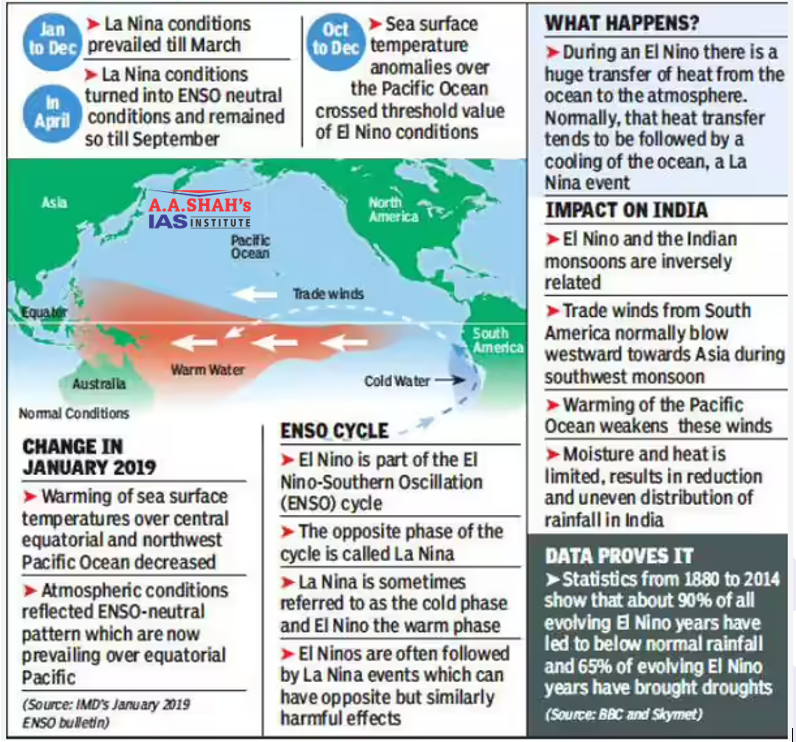
- El Nino is a climate phenomenon characterized by the abnormal warming of surface waters in the central and eastern equatorial Pacific Ocean.
- It is part of the larger El Nino–Southern Oscillation (ENSO) cycle.
- El Nino is closely linked with the Southern Oscillation, which refers to changes in atmospheric pressure across the Pacific.
- The term El Nino means “The Little Boy” or “Christ Child” in Spanish because fishermen off the coast of Peru noticed the warming around Christmas.
Conditions in the Pacific Ocean
Normal conditions:
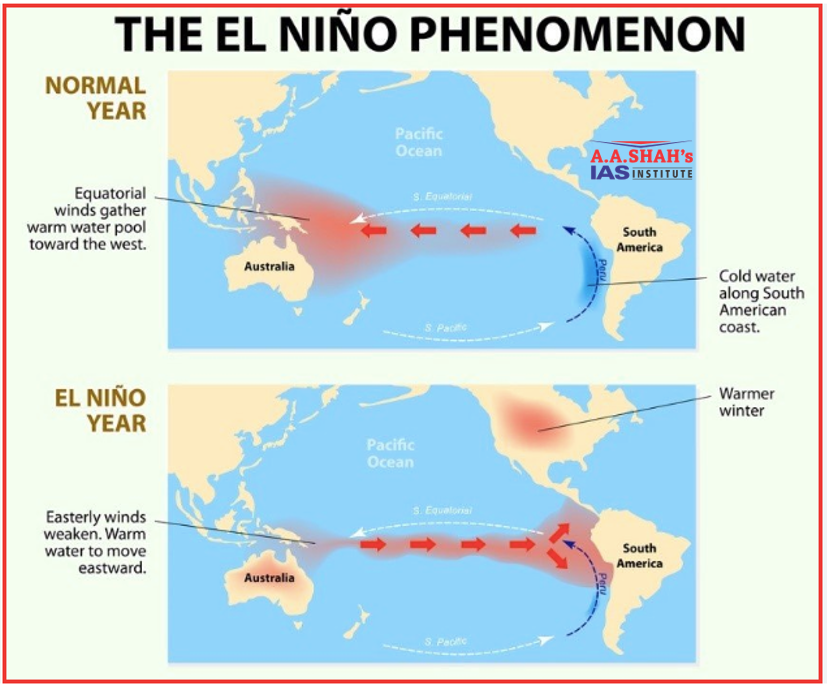
- Trade winds blow from east to west across the tropical Pacific.
- Warm water accumulates near Indonesia and Australia.
- Cold, nutrient-rich water rises near the coast of Peru through a process called upwelling.
- This supports rich fisheries and influences global weather patterns.
During El Niño:
- Trade winds weaken or may even reverse.
- Warm water moves eastward toward the coast of South America.
- Upwelling off Peru decreases.
- Sea surface temperatures in the eastern Pacific become unusually warm.
Causes of El Nino
Scientists believe El Niño develops due to:
- Weakening of trade winds.
- Changes in atmospheric pressure patterns.
- Interaction between ocean currents and the atmosphere.
- Natural variability within the Pacific Ocean system.
It usually occurs every 2–7 years and lasts 9–12 months, though some events persist longer.
Effects of El Nino
1. Impact on Rainfall
- South America – Heavy rainfall and floods in Peru and Ecuador.
- Australia and Indonesia – Droughts and forest fires due to reduced rainfall.
- India – Often associated with weaker monsoons and drought conditions, though not every El Niño year leads to drought.
2. Impact on Fisheries
- Reduced upwelling decreases nutrients in surface waters.
- Fish populations decline.
- Fishing industries along the Peruvian coast suffer.
3. Impact on Global Temperatures
- El Niño years are generally warmer globally.
- Many record-breaking warm years have coincided with strong El Niño events.
4. Extreme Weather
Can increase:
- Heat waves
- Droughts
- Floods
- Wildfires in some regions
El Nino and Indian Monsoon
India’s monsoon depends partly on the temperature contrast between land and ocean.
During El Niño:
- Rising air shifts toward the central/eastern Pacific.
- Rain-bearing systems over South Asia may weaken.
- Monsoon rainfall can be below normal.
Historical Examples
Strong El Niño events were linked with weaker monsoons in years such as:
- 1982–83
- 1997–98
- 2015–16
However, the relationship is not perfect because other factors such as the Indian Ocean Dipole can influence rainfall.
El Nino vs La Nina
| Feature | El Niño | La Niña |
| Pacific Ocean Temperature | Warmer than normal | Cooler than normal |
| Trade Winds | Weak | Strong |
| Upwelling near Peru | Weak | Strong |
| Indian Monsoon | Often weaker | Often stronger |
| Global Temperature | Generally warmer | Generally cooler |
La Niña is essentially the opposite phase of El Niño.
Importance of El Nino
El Niño is important because it affects:
- Agriculture
- Water resources
- Fisheries
- Disaster management
- Food security
- Global climate patterns
What is the Indian Ocean Dipole?
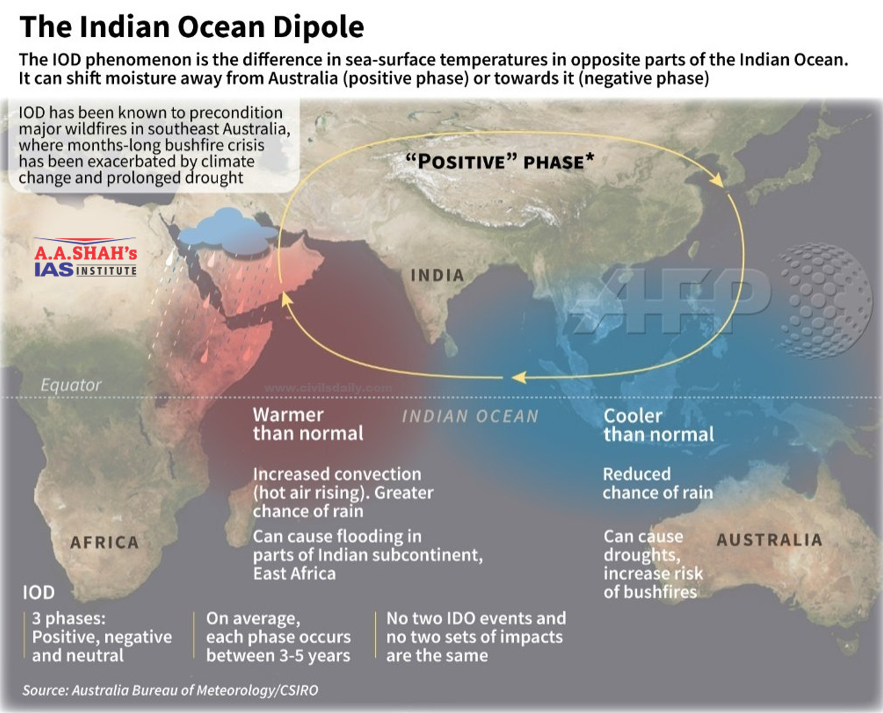
- Indian Ocean Dipole (IOD) is an ocean-atmosphere phenomenon characterized by a difference in sea surface temperatures between the western and eastern parts of the tropical Indian Ocean.
- It is sometimes called the “Indian Nino” because of its similarity to the Pacific Ocean’s ENSO phenomenon.
- The concept was first described by Nerilie Abram and other researchers, with major contributions from Saji N. Hameed and colleagues in 1999.
Types of IOD
1. Positive IOD (+IOD)
In a Positive IOD:
- Western Indian Ocean becomes warmer than normal.
- Eastern Indian Ocean near Indonesia becomes cooler than normal.
- Rainfall increases over East Africa.
- Enhances monsoon in India.
- In some El Nino years, India still received near-normal rainfall because a positive IOD strengthened the monsoon.
- Rainfall decreases over Indonesia and Australia.
2. Negative IOD (−IOD)
In a Negative IOD:
- Eastern Indian Ocean becomes warmer than normal.
- Western Indian Ocean becomes cooler than normal.
- Indonesia receives more rainfall.
- East Africa receives less rainfall.
3. Neutral IOD
- Temperature difference is close to normal.
- Little or no significant dipole effect.
Difference Between El Niño and IOD
| Feature | El Niño | Indian Ocean Dipole |
| Ocean Involved | Pacific Ocean | Indian Ocean |
| Nature | Warming of central/eastern Pacific | Temperature difference within Indian Ocean |
| Frequency | Every 2–7 years | Irregular |
| Main Impact on India | Usually weakens monsoon | Positive IOD usually strengthens monsoon |
| Opposite Phase | La Niña | Negative IOD |