FIFA facing allegations of corruption, abuse of power
SPORTS
14 JUNE 2026
About FIFA
- The FIFA is the global governing body of football and organizer of the FIFA World Cup.
- Founded in 1904 in Paris with 7 member nations.
- Membership has grown to 211 associations, more than the United Nations.
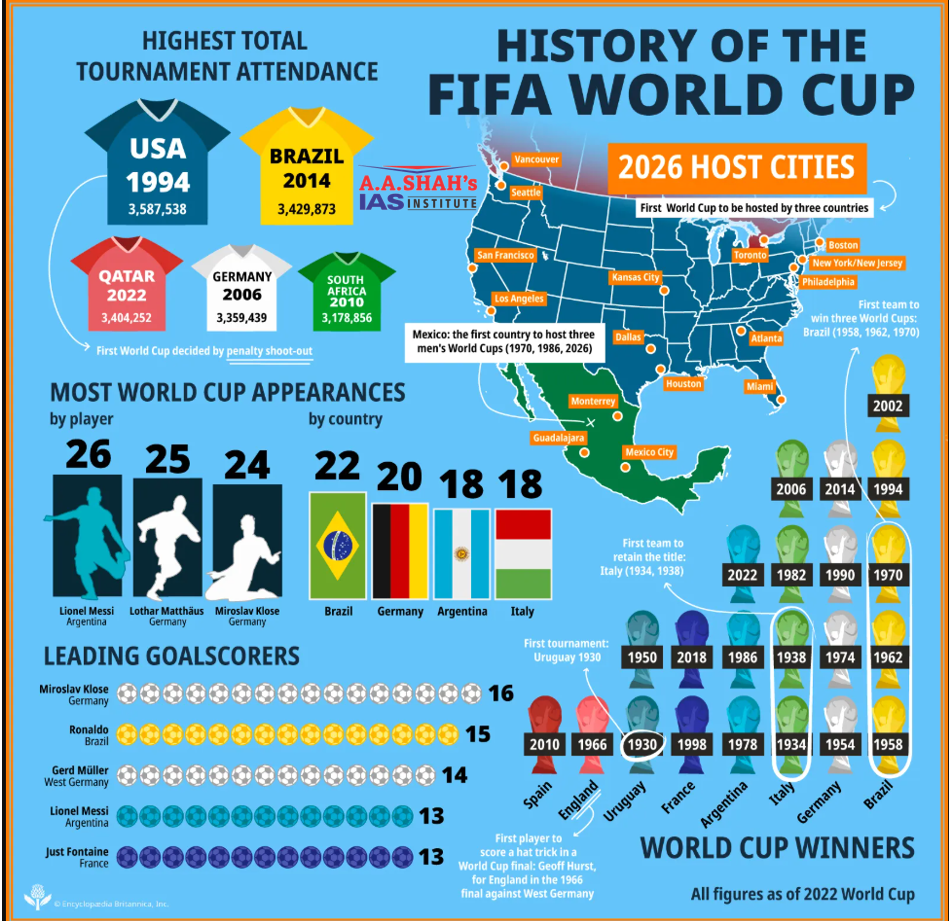
- The World Cup began in 1930 with 13 teams and has expanded to 48 teams and 104 matches.
Growth of FIFA
- FIFA organized Olympic football under Jules Rimet, whose success led to the creation of the World Cup.
- The first World Cup was held in Uruguay in 1930.
- FIFA has become one of the wealthiest sports organizations, with reserves of about $2.69 billion (2025).
Concentration of Power
- FIFA presidents enjoy significant authority and can serve up to three four-year terms.
- Long-serving presidents include:
- Jules Rimet (33 years)
- Stanley Rous (12+ years)
- João Havelange (24+ years)
- Sepp Blatter (17+ years)
- Gianni Infantino (since 2016)
Major Criticisms
- FIFA presidents have often developed close ties with political leaders and authoritarian regimes.
- FIFA’s financial aid to member nations has sometimes been criticized as a tool for securing votes.
- Controversial World Cups:
- 1934 in Italy under Benito Mussolini.
- 1978 in Argentina under Jorge Rafael Videla.
- Corruption scandals surrounded the awarding of the 2018 and 2022 World Cups to Russia and Qatar.
Criticism of Gianni Infantino
- Came to power promising reforms after the Blatter-era scandals.
- Has been criticized for close relations with Vladimir Putin and Donald Trump.
- Supported a major Saudi sponsorship deal while Saudi Arabia prepares to host the 2034 World Cup.
- Seeks an interpretation of term-limit rules that could allow him to remain president beyond 2027.
Immigration and Human Rights Concerns
- FIFA has faced criticism for not strongly opposing immigration restrictions affecting fans, officials, and players.
- The denial of entry to Somali referee Omar Artan became a notable example.
Expansion of FIFA Competitions
- World Cup expanded from 32 to 48 teams.
- FIFA Club World Cup expanded from 7 to 32 teams, increasing FIFA’s influence and revenues.
- Concerns exist about player workload and commercialization of the sport.
Core Issue
- FIFA faces a fundamental conflict: It is expected to be the neutral guardian and regulator of football.
- At the same time, it depends on selling tournaments and generating revenue.
- Critics argue that FIFA’s growing financial and political interests make it difficult for the organization to remain completely impartial—raising the question of whether a body can effectively regulate a sport while also profiting from it.