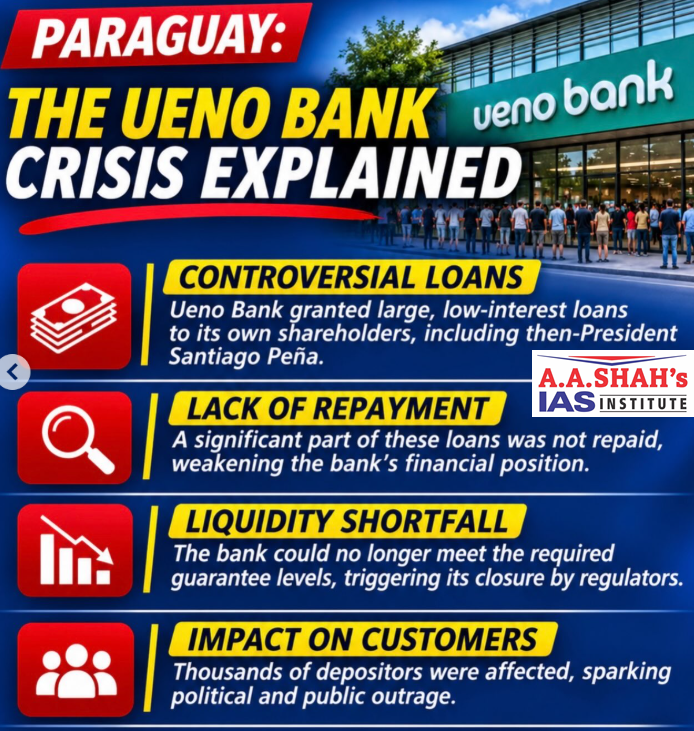
How did a bank collapse bring down Paraguay’s President?
INTERNATIONAL – SOUTH AMERICA
10 NOVEMBER 2026
- Following impeachment proceedings initiated against the country’s President Santiago Pena, Paraguay’s Senate voted to remove him for misconduct in office and placed him under house arrest on November 7, 2026.
- Subsequently, Vice-President Pedro Alliana was sworn in as interim President.
- Both Mr. Alliana and Mr. Pena belong to the Colorado Party.
- The development comes just days after Mr. Pena announced his resignation amid a financial crisis triggered by the collapse of Ueno, a prominent digital lender-turned-bank that catered to nearly half the population.
- Millions of customers, abruptly, lost access to their savings accounts and pension payments after regulators seized the bank on November 3, 2026, setting off a sequence of events that culminated in a change of political leadership.
- Mr. Pena’s resignation had not been formally accepted earlier as lawmakers argued that a voluntarily departure would preserve his eligibility to become a Senator for life and shield him from prosecution under the country’s law.
Why did the Central bank step in?
- Banco Central del Paraguay (BCP), the top monetary authority in the South American country, initiated a resolution process after Ueno’s solvency ratio fell below half the legal minimum.
- Solvency measures whether a bank has enough capital to absorb losses.
- The resolution process adopted by the Central bank is different from bankruptcy.
- It allows regulators to assess the bank’s assets, transfer deposits to other financial institutions, and liquidate remaining assets if needed.
- This led to the freeze of the savings of nearly three million customers and hundreds of millions of dollars in public pension money.
Fraud bu Ueno
- Reports in Paraguayan media have alleged that Ueno repeatedly gave loans to companies tied to the bank’s owners.
- Some of these loans reportedly exceeded legal limits and lacked collateral.
- When adjustments were made to the bank’s financial statements, its capital position was found to be substantially weaker than previously indicated.
- Questions have arisen over whether Ueno was shielded from regulatory oversight due to its government connections.
Connection with government
- Mr. Pena has been linked to bank’s parent company and is alleged to have used his political influence to steer public funds into Ueno.
- He had previously held a stake in Ueno’s parent company and appointed one, Carlos Carvallo to head the Central bank in 2023. Mr. Carvallo had previously run the finance company that would later become Ueno.
Is Ueno a traditional bank? What made it so popular?
- Ueno can be best understood as a bank with a digital-first business model.
- Starting out as a small financial operation in the 1970s, it grew through acquisition, and rose to prominence only in recent years under the brand name Ueno after the financial institution was granted a license by the BCP to operate as a bank in 2023.
- Apart from its flamboyant marketing — ranging from cashbacks at supermarkets to sponsoring the country’s football team — local media reports note that Ueno made it easier to open a bank account and access banking services compared to its competitors.
- Buoyed by some $800 million in public money, Ueno became one of the largest banks in Paraguay in terms of number of depositors.
- It is said to have onboarded more than two-thirds of the country’s adults into its banking services. The bank’s website flaunts the tagline ‘2 out of 3 Paraguayans use Ueno’ on its homepage, reflecting its claim of customer reach.
What happens to the money parked in the bank?
- The bank reportedly held $800 million in public funds.
- A significant portion, about $350 million, belonged to Paraguay’s Social Security Institute, the country’s state pension and healthcare fund.
- The main concern is whether the money can be recovered in full.
- Paraguay has a Deposit Guarantee Fund, which protects eligible depositors up to 75 monthly minimum wages.
- The fund insures up to about $36,000 per customer.
- The BCP says that covers the full balances of an estimated 97% of customers, but the timeline for distributing the funds is yet to be known.
- This protection applies to the combined deposits held by a customer at the bank, not separately to every account.