How WhatsApp and a clot-buster eased rural access to heart care
SOCIAL – HEALTH
31 MAY 2026
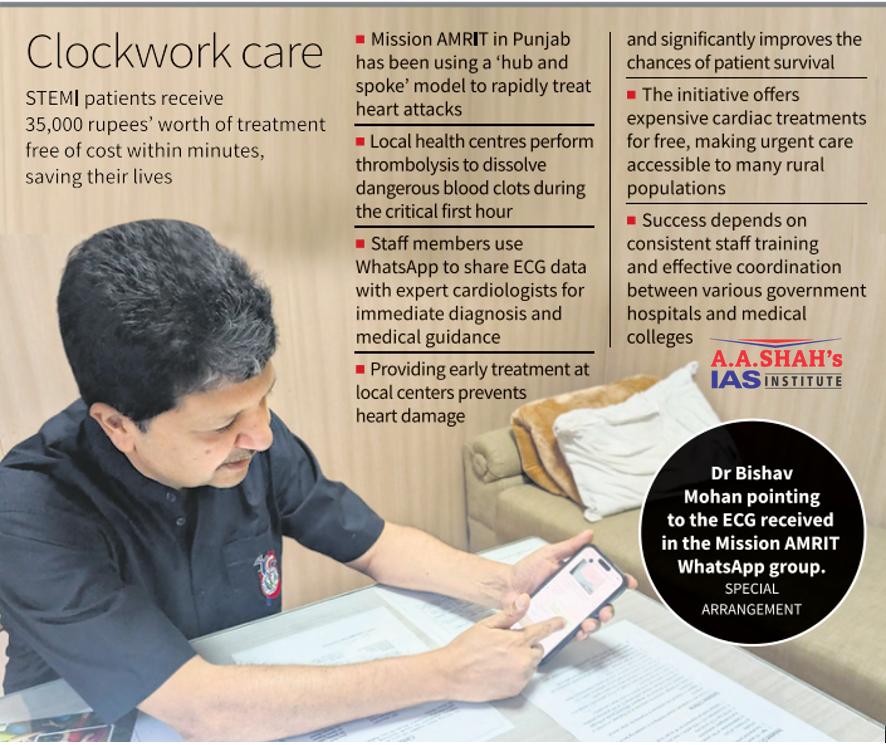
- Since July 2025, the Punjab government has implemented Mission AMRIT (short for ‘Acute Myocardial Reperfusion in Time’), where sub-divisional hospital and district hospital staff — the spokes — are equipped with drugs, equipment, and training to conduct thrombolysis under the guidance of a cardiologist or a specialist in the medical colleges, which are the hubs.
- When a person with STEMI reaches the spoke within up to 12 hours of a heart attack and no complications, they are thrombolysed and referred to a hub for further angiography and angioplasty.
- An echocardiogram (ECG) result WhatsApped to the hospital’s medicine consultant diagnosed it as an ST-elevated myocardial infarction (STEMI) and asked the EMO to administer the drug tenecteplase.
- STEMI is a severe, life-threatening heart attack with significant coronary artery blockage.
- The injected drug tenecteplase is used for thrombolysis, or to dissolve the clot.
- The patient received the injection within half an hour of his ECG results and soon felt better.
- After the successful Tamil Nadu STEMI pilot showed a hub and spoke model could reduce mortality, it was implemented in Goa, Karnataka, Andhra Pradesh, and elsewhere.
- But including only the government hospitals as hubs reduces the model’s efficacy.