Industrial output slows in new data series
ECONOMY – INDICATORS
2 JUNE 2026
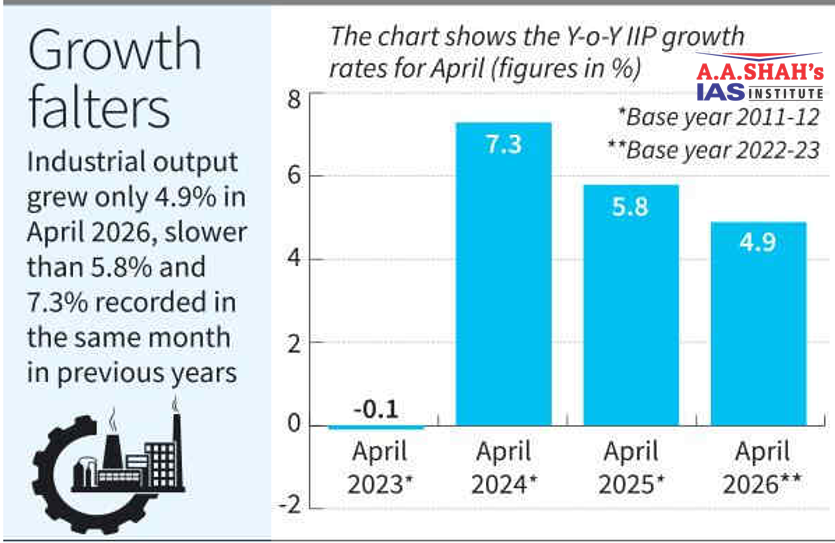
- India’s industrial output, as measured by the Index of Industrial Production, grew 4.9% in April 2026 under the revised series with 2022-23 as base year.
- It was released by Ministry of Statistics and Programme Implementation.
- The growth rate was slower than 5.8% recorded in the same period in 2025 with 2011-12 as base year.
New Series
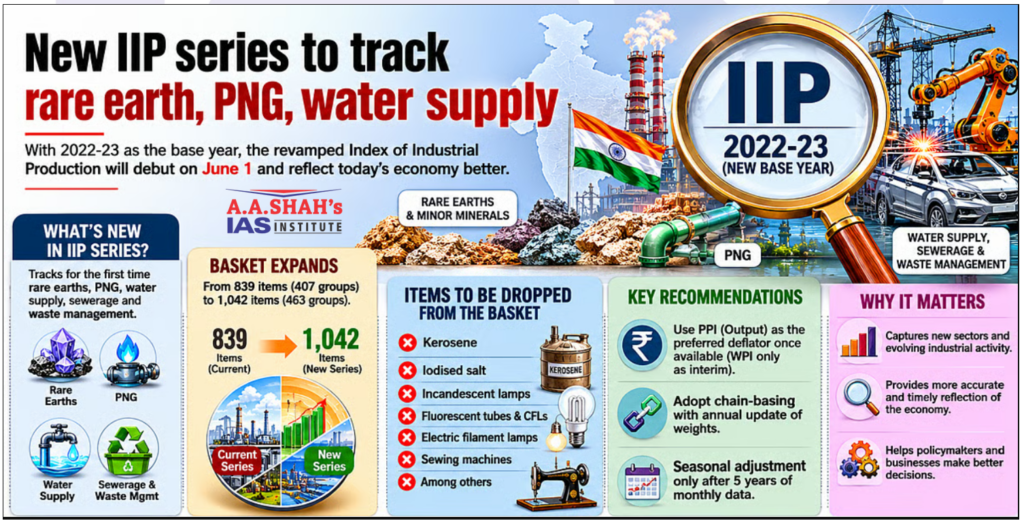
- The new series has broadened the coverage of the index.
- New products and sectors have been incorporated and several obsolete items dropped.
- While retaining the existing three core sectors — mining, manufacturing, and electricity; a fourth major sector — water supply, sewerage and waste management — has been introduced with a weight of 2.02%.
- Further, the weights provided to each sector and each industry within the manufacturing sector has been revised in line with the updated Gross Value Added (GVA) 2022-23 series.
- The electricity category has been expanded into Electricity and Gas Supply, with its weight rising to 10.87% from 7.99% earlier.
- Manufacturing remains the dominant component of the index, though its weight has declined marginally to 76.06% from 77.63%.
- More notable is the reduction in the weight of mining and quarrying to 11.05% from 14.37%.
- These shifts suggest that the importance of value-added infrastructure and utility services in gauging industrial activity has expanded, while the relative significance of primary resource extraction has diminished.
- Besides adding new sectoral divisions, the new series also entails “improved granularity”. For instance, mining sector index will now include data classification for fuel minerals, metallic minerals, and non-metallic minerals. Similarly, the electricity index has been classified into renewable and non-renewable sources.
- The new basket of goods to calculate IIP consists of 1,042 products mapped to 463 item groups.
- The older series had just 839 items mapped to 407 item groups.
New base year
- The base year to assess major macroeconomic indicators, which was earlier 2011-12, was revised as 2022-23 in 2026 beginning with the GDP estimates.
- The IIP is the latest estimate to adopt 2022-23 as the base year.
- The dataset will assume the index to be 100 as of 2022-23 and then calculate the growth rate of the index in subsequent years.
April 2026 data
- Capital goods output expanded by a robust 16% year-on-year, reflecting the continuing effects of elevated public capital expenditure and infrastructure spending.
- By contrast, consumer durables output grew only 4.3%, while consumer non-durables expanded by a modest 2.8%, suggesting that rising fuel and energy costs may be exerting pressure on household consumption.