Is India getting hotter?
ENVIRONMENT – CLIMATE CHANGE
31 MAY 2026
- Several cities in India are sweltering under heatwaves or quasi-heatwave-like conditions.
- An India Meteorological Department (IMD) study of the Core Heatwave Zone (CHZ) over 1961–2020 found heatwave frequency rising 0.1 days per decade and duration 0.44 days per decade, both statistically significant trends.
- The study also found that nights warmed faster than days, at roughly 0.21°C per decade.
- The CHZ includes Punjab, Himachal Pradesh, Uttarakhand, Delhi, Haryana, Rajasthan, Uttar Pradesh, Gujarat, Madhya Pradesh, Chhattisgarh, Bihar, Jharkhand, West Bengal, Odisha, and Telangana, plus the meteorological subdivisions of Marathwada, Vidarbha, and Madhya Maharashtra, and coastal Andhra Pradesh.
- Heatwaves are becoming more frequent and longer over the decades, but May 2026 itself was a wet, regionally uneven month rather than a record-setting one.
- A widely shared list claimed all 50 of the world’s hottest cities were in India in April.
- The ranking, compiled by an air-quality website, captured a single day — April 27, 2026 — and presented it as a climate signal.
- The absence of cities from West Asia, Africa, or Australia reflects the composition of the dataset.
- Ranking by 24-hour average temperature also favours places with warm nights and penalises desert cities that cool sharply after dark, which is why Rajasthan, home to India’s all-time temperature record, appeared near the bottom.
Urban heat islands and role of air-conditioning
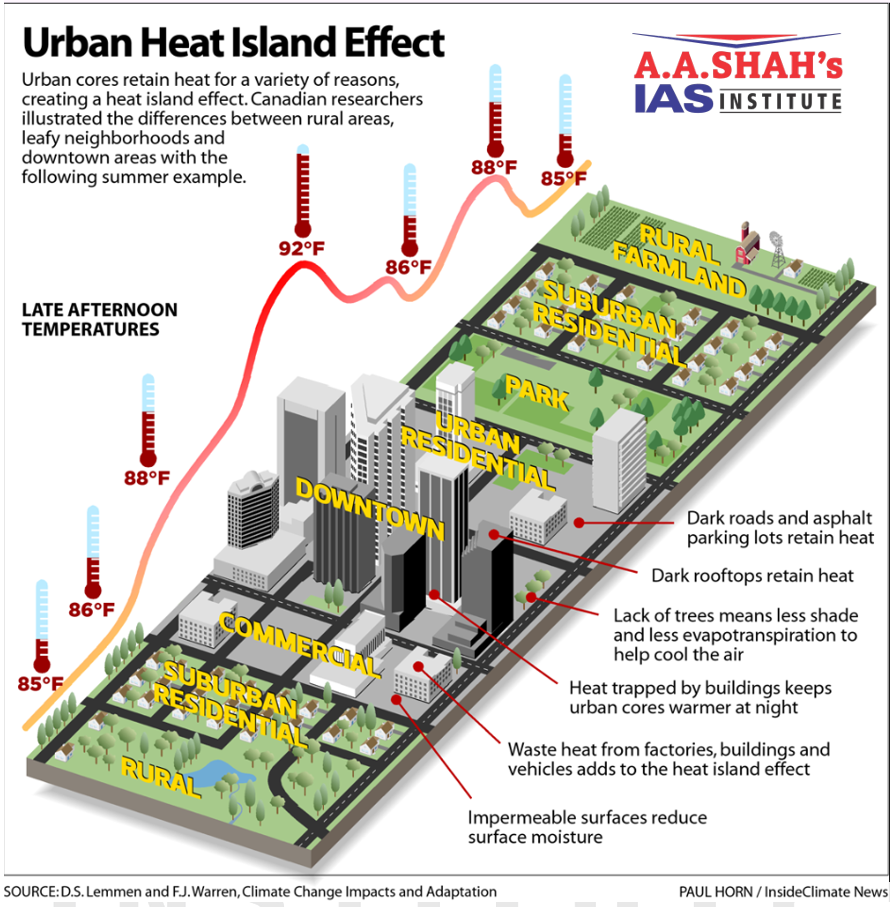
- When a city replaces soil and vegetation with concrete and asphalt, those surfaces absorb heat during the day and release it slowly at night.
- Combined with reduced evaporative cooling, low surface reflectivity, poor ventilation, and waste heat, this can make Indian cities 2–10°C hotter than surrounding rural areas, with the gap largest at night.
- Air-conditioning compounds it: each unit cools an interior by expelling heat outdoors.
El Nino’s effect on temperatures and the monsoon
- It raises the risk of a hotter, drier season.
- El Nino tends to weaken the monsoon’s moisture-bearing uplift, which can lengthen dry “break” spells and trigger humid heatwaves across the north-west.