Jan Vishwas (Amendment of Provisions) Bill, 2026 passed
POLITY – BILL/ACT
9 APRIL 2026
- The passage of the Jan Vishwas (Amendment of Provisions) Bill, 2026 by Parliament reflects a conscious and forward-looking policy choice by the Government of India to recalibrate the balance between enforcement and facilitation, and to embed trust as a central pillar of the regulatory framework.
- The reform signals a clear departure from over-reliance on criminal sanctions toward a more proportionate, predictable, and facilitative approach to compliance.
Decriminalisation of minor business-related offences
- In recent years, the decriminalisation of minor business-related offences has emerged as a core element of India’s reform agenda.
- The underlying objective has been consistent:
- to rationalise compliance requirements
- enhance ease of doing business
- foster a regulatory culture that promotes voluntary compliance rather than fear-driven adherence.
Disadvantages of Excessive Criminalisation of technical and procedural lapses
- compliance anxiety,
- discouraged entrepreneurship,
- diverted administrative and judicial resources from more serious violations.
Jan Vishwas (Amendment of Provisions) Act, 2023
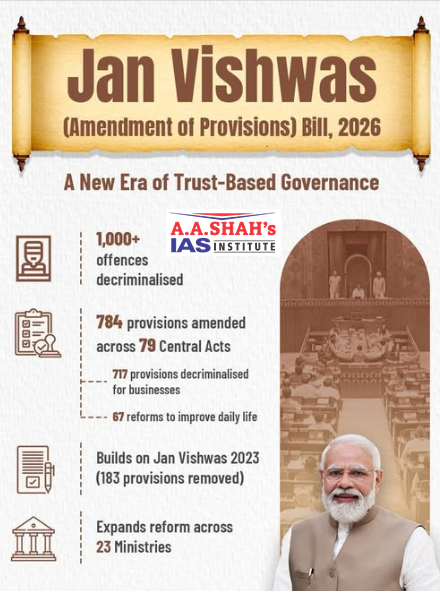
- Jan Vishwas (Amendment of Provisions) Act, 2023, decriminalised minor offences by amending 183 provisions across 42 Central Acts administered by 19 Ministries and Departments.
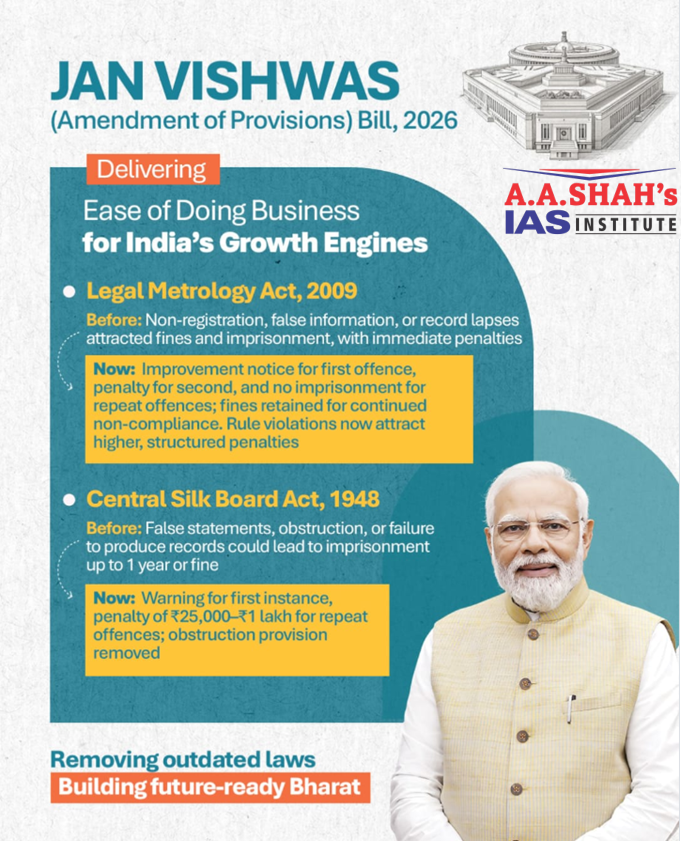
- By replacing criminal penalties for technical and procedural non-compliances with civil penalties or administrative measures, it significantly reduced the compliance burden on businesses and citizens, improving both ease of doing business and ease of living.
Jan Vishwas 2.0
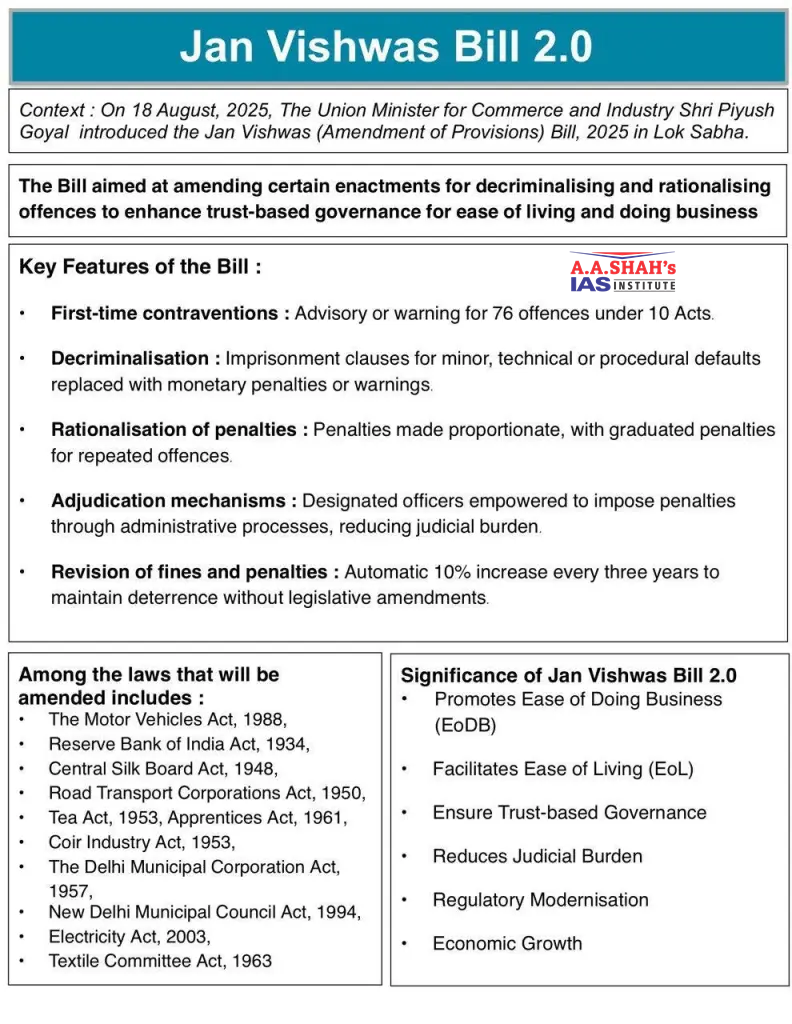
- The 2026 Bill, commonly referred to as the Jan Vishwas 2.0, proposes amendments to 784 provisions across 79 Central Acts administered by 23 Ministries and Departments, including the decriminalisation of 717 provisions.
- It also rationalises the statute book by removing obsolete and redundant offences, thereby strengthening the coherence and credibility of India’s overall regulatory architecture.
- The Confederation of Indian Industry (CII) has shaped this reform agenda through sustained, evidence-based policymaker engagement.
- Industry representations consistently highlighted a large number of statutory offences related to minor and procedural lapses — delays in filings, documentation gaps or clerical errors — that did not warrant criminal prosecution.
- A persistent industry recommendation has been to move away from court-imposed ‘fines’ toward a system of regulatory ‘penalties’ administered by executive authorities, with clear rules, proportionality, and time-bound resolution.
- The CII has also stressed the need for the retrospective application of decriminalisation reforms, covering cases currently pending in criminal courts.
- The Jan Vishwas 2.0 seems to address these long-standing concerns very well.