Maharashtra’s Ladki Bahin scheme under scrutiny
SOCIAL – SCHEMES
17 JULY 2026
- Ahead of the 2024 Assembly elections, the Maharashtra government launched the Mukhyamantri Majhi Ladki Bahin Yojana.
- Under this scheme, eligible women in the State receive ₹1,500 every month through Direct Benefit Transfer (DBT).
- At its peak, the scheme covered 2.43 crore beneficiaries.
- However, successive rounds of verification over the past two years have led to the removal of lakhs of beneficiaries, bringing the total down to about 1.66 crore women.
- The recent information about the removal of lakhs of women from the beneficiaries’ list has sparked criticism, and the Comptroller and Auditor General (CAG) has raised concerns about the scheme.
Eligibility
- Women who are residents of Maharashtra, aged between 21 and 65 years, with an Aadhaar-linked bank account, and belonging to a family with an annual income of less than ₹2.5 lakh are eligible to receive benefits under the scheme.
- Women of any marital status are eligible.
- However, only one woman per family can avail of the benefit.
Objective
- The State government has said the scheme is aimed at promoting the economic independence of women.
- It also seeks to improve their health and nutritional status, and strengthen their role in family decision-making, according to the government.
- The scheme is implemented by the State’s Women and Child Development Department.
Red Flags Raised by the CAG
1. Poor Budget Planning & Financial Management
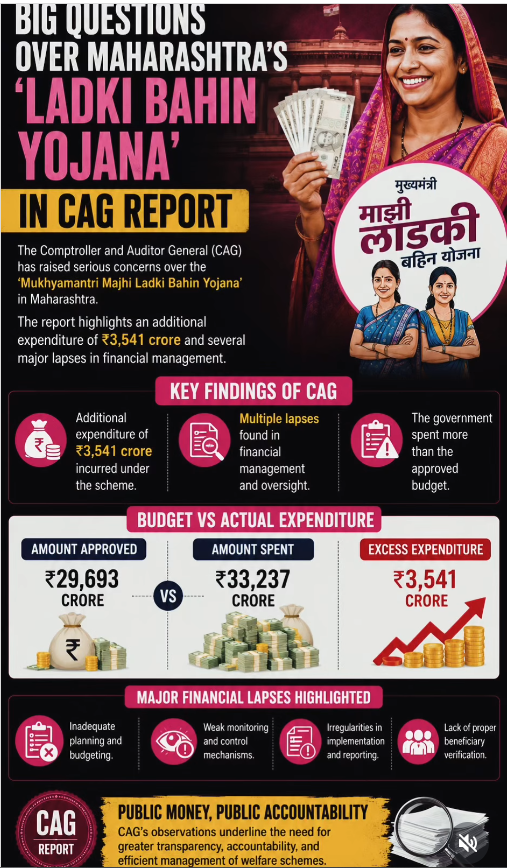
- The CAG highlighted major deficiencies in budget estimation, expenditure control, and financial management during the implementation of the scheme.
2. Excess Expenditure
- Budget allocation: ₹29,693.09 crore
- Actual expenditure: ₹33,237.24 crore
- Excess spending: ₹3,541.16 crore
3. Unjustified Overspending
- The CAG termed the excess expenditure as “unjustified” and noted that the Women and Child Development Department failed to provide a proper explanation.
4. Diversion of Funds Through Reappropriation
- Funds were arranged by reappropriating allocations from other schemes.
- ₹3,490.75 crore was transferred from the Lek Ladki Yojana.
5. Additional Budget Allocation
- The Supplementary Budget allocated an additional ₹26,200 crore for the scheme.
6. Violation of Budgetary Principles
- The CAG stated that the scheme undermined:
- Budgetary discipline
- Financial propriety
- Legislative control over public finances
7. Parking of Funds Without Immediate Requirement
- Large amounts were drawn and kept in the Disbursing Officer’s Virtual Personal Deposit Account (VPDA).
8. Lack of Financial Discipline
- The CAG observed that funds were withdrawn without actual expenditure needs, indicating poor financial management and violation of budgetary discipline and financial propriety.
Why Have Many Names Been Removed from the Beneficiaries’ List?
1. Reduction in Beneficiaries
- At its peak, the scheme had 2.43 crore beneficiaries.
- The number has now reduced to 1.66 crore beneficiaries.
2. Verification Process
- The Maharashtra government stated that names were removed after multiple rounds of verification found some beneficiaries were no longer eligible.
- It maintained that eligibility criteria remained unchanged.
3. e-KYC Requirement
- The government identified the mandatory e-KYC process as a major reason for the decline.
- Many women failed to complete the required e-KYC verification, leading to their exclusion.
4. Demand for Extension of e-KYC Deadline
- A Shiv Sena leader has urged the State government to extend the deadline for completing the e-KYC process.
5. Opposition’s Allegations
- The Opposition accused the government of using the scheme for electoral gains.
- The Congress demanded:
- Immediate restoration of benefits for women excluded due to e-KYC issues.
- An inquiry into the implementation of the scheme.
6. Unfulfilled Promise on Financial Assistance
- The Opposition criticised the government for not increasing the monthly assistance from ₹1,500 to ₹2,100, as promised before the State Assembly elections.