MGNREGA 2005 is set to be replaced by VB-G RAM G 2025
SOCIAL – SCHEMES
13 JUNE 2026
- MGNREGA was launched in 2006 and completed 20 years of implementation in February 2026.
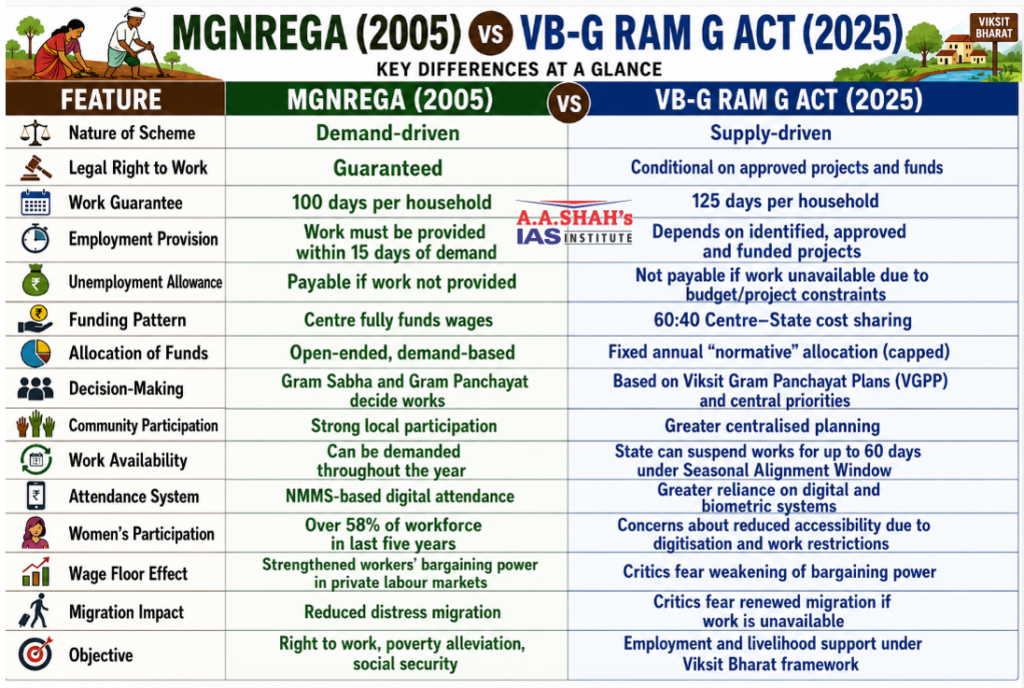
- Women have consistently formed a majority of the workforce, accounting for more than 58% of total workers during the last five years.
- Although the Act guarantees 100 days of employment per household annually, the average employment generated per household has remained around 45 days.
- The average wage rate under MGNREGA increased from ₹282.2 per person per day in 2021–22 to ₹342 per person per day in 2025–26.
- The new VB-G RAM G Act, 2025 proposes to increase the employment guarantee from 100 days to 125 days per household.
- The Union Government has allocated ₹92,550.17 crore as the interim budget for the implementation of VB-G RAM G across States.
- Out of this amount, Karnataka has been allotted ₹5,709.9 crore under the new scheme.
Significance of MGNREGA
- MGNREGA was the first major legislation in India to provide a legally guaranteed Right to Work for rural households.
- The scheme promoted equal wages for men and women, helping reduce gender-based wage discrimination.
- It enhanced women’s financial inclusion by enabling many women to obtain job cards and open bank or post-office accounts in their own names.
- MGNREGA established a wage floor in rural labour markets, strengthening workers’ bargaining power against exploitative wages.
- By providing employment opportunities within villages, it helped reduce distress migration to urban areas and other states.
- The scheme acted as an important social security safety net, particularly during periods of economic hardship, droughts, and other crises.
Major Criticisms of VB-G RAM G
- End of Demand-Based Guarantee
- Employment depends on approved projects and available funds.
- Critics argue this weakens the “right to work”.
- Capped Employment
- States receive fixed allocations.
- Additional demand may remain unmet once allocations are exhausted.
- State Funding Burden
- States must contribute 40% of costs.
- Several States have raised concerns over fiscal stress.
- Seasonal Alignment Window
- States can halt works for up to 60 days during sowing and harvesting seasons.
- No unemployment allowance during this period.
- Increased Digitisation
- Greater dependence on biometric attendance and digital monitoring.
- Connectivity and technical failures may affect wage payments.
- Reduced Local Autonomy
- Shift from Gram Sabha-led planning to centrally guided priorities.