Rationalising Iran’s nuclear capability
INTERNATIONAL – ASIA
4 MAY 2026
- Under pressure from U.S. President Donald Trump to abandon its nuclear programme, Iran has “vowed” to protect its nuclear stockpile.
- At the same time, former supreme leader Ayatollah Ali Khamenei disapproved of the use of nuclear weapons on religious grounds. How does Iran reconcile the two positions?
- Iran joined the NPT in 1970 but has recently expressed doubts about its participation.
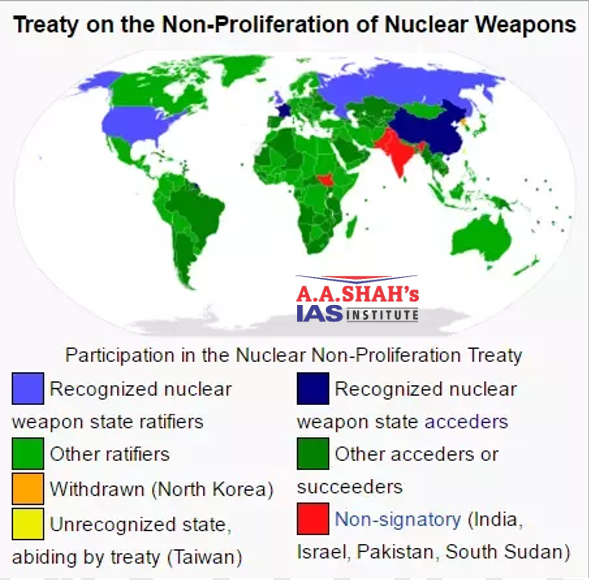
Treaty on the Non-Proliferation of Nuclear Weapons (NPT)
- It is a landmark international accord aimed at preventing the spread of nuclear weapons, promoting cooperation in the peaceful use of nuclear energy, and advancing nuclear disarmament.
- It is in force since 1970 and extended indefinitely in 1995.
- Key Provisions:
- Non-Proliferation: Non-nuclear-weapon states pledge not to acquire/produce nuclear weapon
- Disarmament: Nuclear-weapon states commit to pursuing negotiations to eventually eliminate their nuclear arsenals.
- Peaceful Use: Parties have the right to develop nuclear energy for peaceful purposes under international safeguards.
- The treaty recognizes five nuclear-weapon states: The United States, Russia, China, France, and the United Kingdom
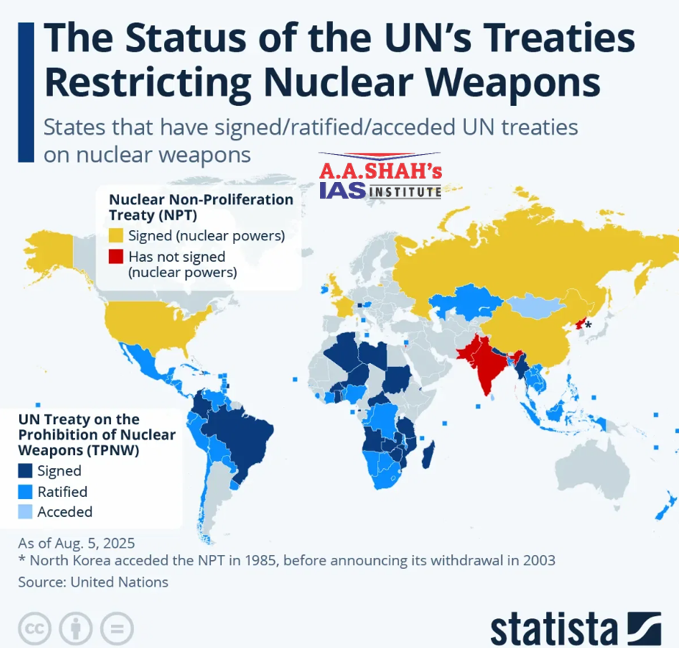
- It boasts nearly 190 state parties. However, India, Israel, and Pakistan have never signed it.
- NPT discourages countries from developing nuclear weapons, but does not prevent them from developing the ability to make these weapons.
- This is ostensibly because some of the same technologies and processes are necessary in a civilian nuclear programme, such as generating nuclear power and making nuclear isotopes for medical use.
- But the NPT expects the civilian programme to include some safeguards like closely monitoring the use of technologies like uranium enrichment and plutonium reprocessing.
- The International Atomic Energy Agency (IAEA) contributes as an independent watchdog that performs intrusive inspections.
- The NPT is reviewed every five years to evaluate its efficacy, with the next review conference scheduled for 2026.
International Atomic Energy Agency (IAEA)
- IAEA was established in 1957 as the world’s “Atoms for Peace and Development” organization,
- It is headquartered in Vienna, Austria.
- It promotes safe, secure, and peaceful nuclear technologies while implementing safeguards to prevent nuclear proliferation
How close is Iran to a nuclear weapon?
- Iran is a threshold state, capable of beecoming a nuclear-weapon state, with a breakout time widely understood to be in the order of a few weeks.
- It is also thought to possess around 500 kg of uranium enriched to 60%.
- Nuclear power reactors require uranium enriched to significantly under 20%.
- Weapons-grade uranium requires 90%.
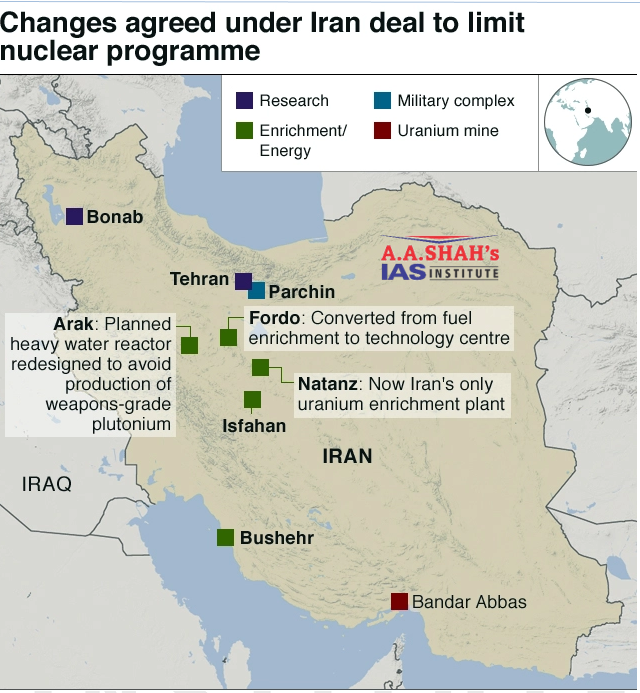
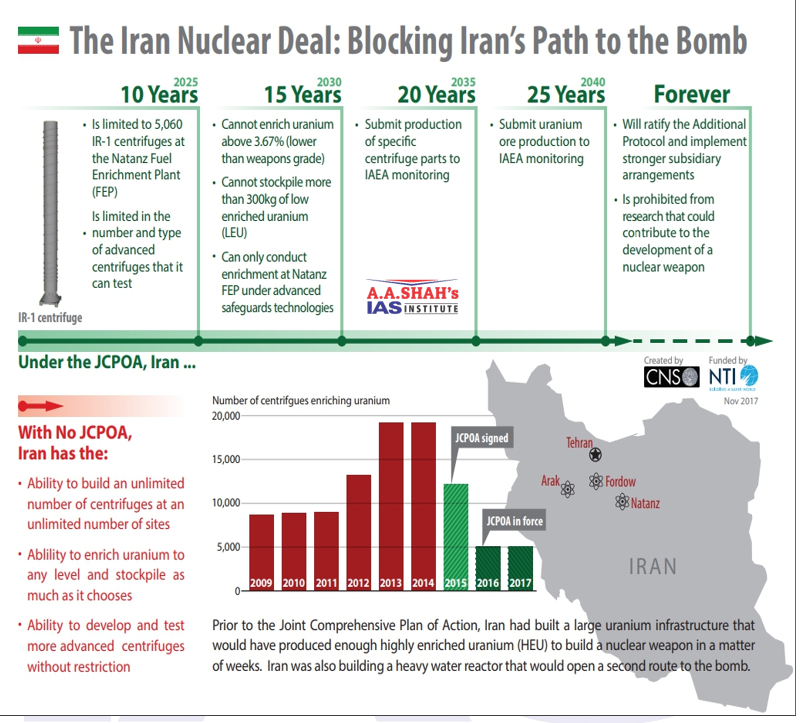
- Iran abided by the 2015 Joint Comprehensive Plan of Action (JCPOA), a.k.a. the Iran deal, until Mr. Trump unilaterally exited it in 2018.
Joint Comprehensive Plan of Action (JCPOA),
- JCPOA, known as Iran Nuclear Deal, is a 2015 agreement between Iran and the P5+1 (USA, UK, France, China, Russia, plus Germany) designed to ensure Iran’s nuclear program remains peaceful.
- It imposed limits on uranium enrichment and heavy-water reactors, subjected facilities to IAEA monitoring, and provided sanctions relief.
- In 2018, the US, during first term of President Trump, withdrew, leading to reduced compliance by Iran.
Treaty on the Prohibition of Nuclear Weapons (TPNW)
- It is a legally binding UN instrument that entered into force on January 22, 2021, marking the first global agreement to comprehensively prohibit nuclear weapons.
- It prohibits the development, testing, possession, use, or stationing of nuclear weapons, aiming for their total elimination.