RBI raises repo rate to 5.5% amid ‘calibrated tightening’
ECONOMY – INDICATORS
8 OCTOBER 2026
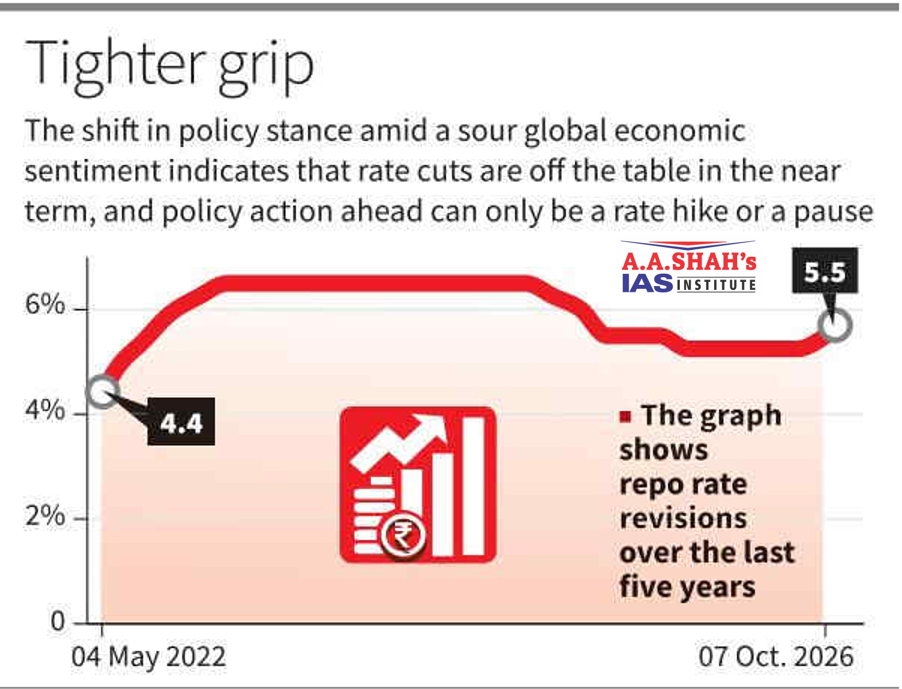
- The Monetary Policy Committee (MPC) of the Reserve Bank of India (RBI) raised the policy repo rate under the liquidity adjustment facility (LAF) by 25 basis points to 5.50% and shifted its stance from neutral to calibrated tightening, signalling that rate cuts are off the table in the near term.
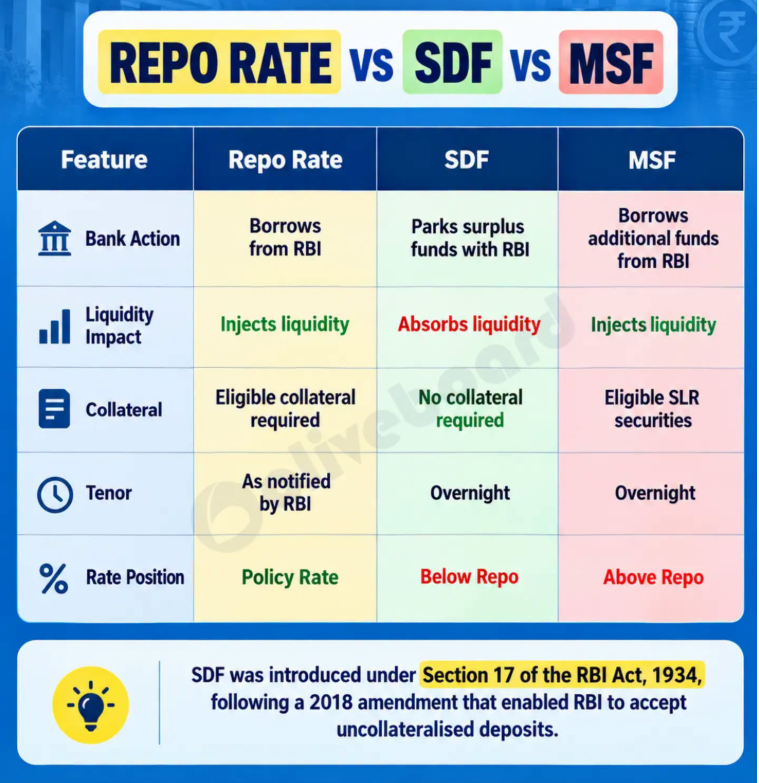
- Consequently, the standing deposit facility (SDF) rate stands adjusted to 5.25%, and the marginal standing facility (MSF) rate and the bank rate to 5.75%.
Repo Rate over time
- The policy repo rate, which was cut to 5.25% in December 2025, had been kept on hold at the next four MPC meetings. In the easing cycle, the MPC had cut the rate by 125 basis points in phases, from 6.50% to 5.25%, before increasing it now.
Global financial conditions
- The sudden re-escalation of the West Asia conflict in September 2026 and the consequent hardening and volatility in global crude prices soured global economic sentiment and unsettled financial markets, RBI Governor Sanjay Malhotra said in a statement.
- Further tightening of global financial conditions, uncertainty about fair valuation of AI stocks and an elusive resolution of the West Asia conflict pose significant downside risks to the global economic outlook, he highlighted in his statement.
- “Although global growth remains resilient, it is projected to decelerate in 2026 from the previous year. Driven by escalating energy costs and rising food prices, global inflation is projected to increase sharply prompting monetary policy tightening by major central banks,” he said.
- “Lingering trade uncertainty, rising bond yields in advanced economies and an appreciating dollar are keeping global financial market sentiments nervous and fragile,” he pointed out.
| Liquidity Adjustment Facility (LAF) It is a monetary policy tool used primarily by the Reserve Bank of India (RBI) to manage day-to-day liquidity mismatches and control short-term interest rates in the banking system. Key Components of LAF Repo Rate (Repurchase Agreement): It is the rate at which the RBI lends short-term money to commercial banks against government securities. This injects liquidity into the banking system. Reverse Repo Rate: The rate at which the RBI borrows surplus funds from commercial banks. This absorbs excess liquidity from the market. Standing Deposit Facility (SDF) and Marginal Standing Facility (MSF): The SDF serves as the lower bound of the liquidity corridor to absorb liquidity without collateral, while the MSF acts as the upper bound for emergency overnight borrowing at a higher rate. Main Objectives Manage Cash Flow: Helps commercial banks cover short-term or overnight cash shortages and deploy excess cash. Control Inflation: Raising the repo rate makes borrowing more expensive, which cools down credit growth and inflation; lowering it stimulates the economy. Stabilize Rates: Forms an interest rate corridor that anchors the overnight money market rates. |