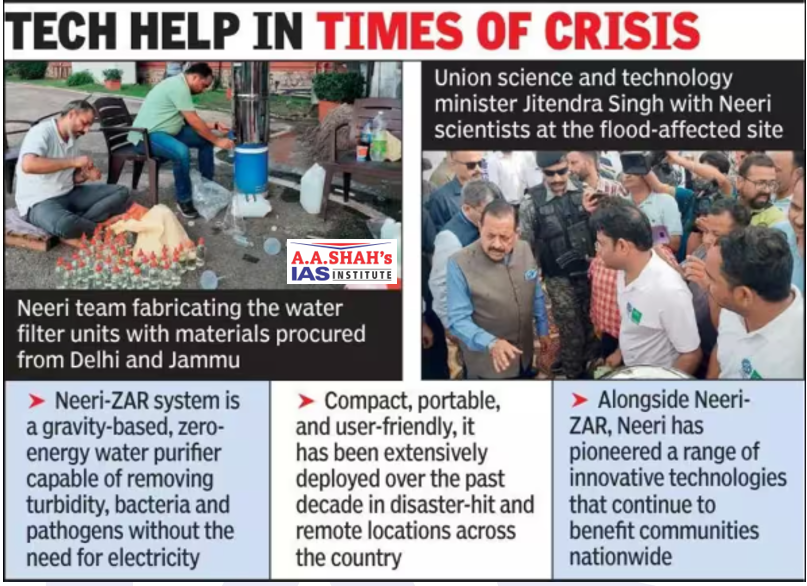
Water purifiers developed during Rajasthan deluge delivered to Assam
S&T – INDIA
10 AUGUST 2026
- A set of specialised water purifiers developed during the 2006 deluge in Barmer, Rajasthan, have been delivered to the flood-hit districts of Charaideo, Jorhat, and Sivasagar in eastern Assam.
- Scientists from the Nagpur-based Council of Scientific and Industrial Research–National Environmental Engineering Research Institute (CSIR-NEERI) began distributing 100 units of the gravity-based emergency insta-portable water purification system. The system is called NEERI-ZAR.
- Of the 100 units, 25 are community-based, and 75 are household units. Collectively, they can produce 2,500 litres of purified water per hour, require no electricity, and have no operational cost.
- They can purify ambient water from rivers, ponds, and wells by removing suspended matter, turbidity, and microbial contamination.
- According to the scientists, the NEERI-ZAR unit meets the requirements for drinking and cooking water in emergencies and will ensure a stable drinking water supply in flood-affected regions.
- Designed for easy operation, the unit is easy to transport and install.
- The technology was developed in 2006, during the Barmer floods. It was improvised and deployed during the 2009 cyclone in the Sundarbans, Uttarakhand (2013), Chennai (2015), Kerala (2018), and Bihar (2019).
Technology behind NEERI-ZAR
- The technology behind NEERI-ZAR relies on a four-stage multi-barrier filtration process that functions entirely via gravity. It combines physical filtration with chemical oxidation and disinfection to turn highly contaminated, muddy water into safe drinking water.
- The 4-Stage Treatment Process
- Oxidation & Coagulation
- Raw water is treated with bleaching powder and alum in the top container.
- Bleaching powder oxidizes organic matter and begins killing pathogens.
- Alum clumps fine mud particles together so they can settle easily.
- Sedimentation
- Water sits undisturbed for a short period in the upper chamber.
- Heavy flocculated mud particles settle to the bottom of the container.
- Clearer surface water flows down to the next stage via gravity.
- Filtration Bed
- Water passes through a multi-layered physical filter bed.
- Peas gravel filters out remaining large, suspended particles.
- A fine sand layer traps smaller microscopic impurities and micro-flocs.
- Disinfection
- Water enters the final storage and collection chamber.
- Residual chlorine from the first stage ensures ongoing disinfection.
- The final water is free of pathogens and safe to drink.
Technical Performance Metrics
- Turbidity Reduction: Drops raw water turbidity from a high 300-500 NTU down to less than 1 NTU.
- Pathogen Removal: Eliminates nearly 100% of harmful bacteria and coliforms.
- Flow Rate: Produces roughly 100 to 120 litres of clean water per hour in the community model.
- Maintenance: Filters require periodic backwashing or sand washing with clean water to prevent clogging.