What India’s 12 ‘operationally deployed’ nuclear warheads really mean
DEFENCE
30 JUNE 2026
- The Stockholm International Peace Research Institute (SIPRI) released its annual yearbook in June 2026.
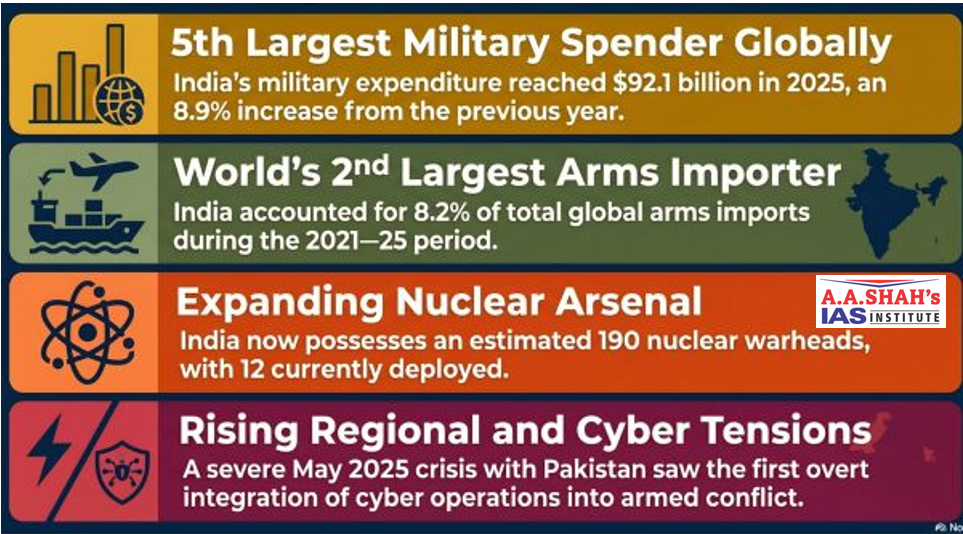
- For the first time, it classified 12 of India’s estimated stockpile of 190 nuclear warheads to be operationally deployed, i.e., positioned with active military forces mated with delivery systems and ready for use.
- This sounds alarming — but the alarm itself may not be warranted.
- The reason is that India has neither crossed a strategic threshold nor has it abandoned its decades-old ‘no first use’ policy.
India’s ‘no first use’ (NFU) policy
- India’s ‘no first use’ (NFU) policy is a pillar of its nuclear doctrine and its credible minimum deterrence posture.
- India has reaffirmed its commitment to NFU and to the non-use of nuclear weapons against non-nuclear-weapon states.
Stockpile vs Deployment
- For most of its nuclear history, India has kept its warheads in a de-mated state, meaning the warheads were stored separately from their delivery vehicles, in a central storage site and under strict civilian and political oversight.
- The idea was to maximise safety, reduce the risk of accidental use, and signal restraint to the international community.
- Deployment, on the other hand, means a weapon has been paired with a delivery system — a missile, aircraft, or submarine — and positioned with operational military forces in a state of readiness.
NFU : a doctrine that relies on retaliation
- Bearing in mind India’s pursuit of a doctrine of credible minimum deterrence centred on assured retaliation, the maturation of its submarine-based deterrent doesn’t depart from NFU but is a means of strengthening it.
- A doctrine that relies on retaliation requires forces capable of surviving an adversary’s first strike. Land-based missiles, however capable, sit at known and mappable locations. An adversary confident in its intelligence could, in theory, target them in a disarming first strike before a retaliatory order is ever issued.
- On the other hand, a stealth submarine operating in the ocean can’t be found, tracked or destroyed in time.
- With three operational SSBNs sufficient to keep at least one submerged and on patrol at all times, India has closed the central vulnerability any NFU doctrine faces.
Global Trend
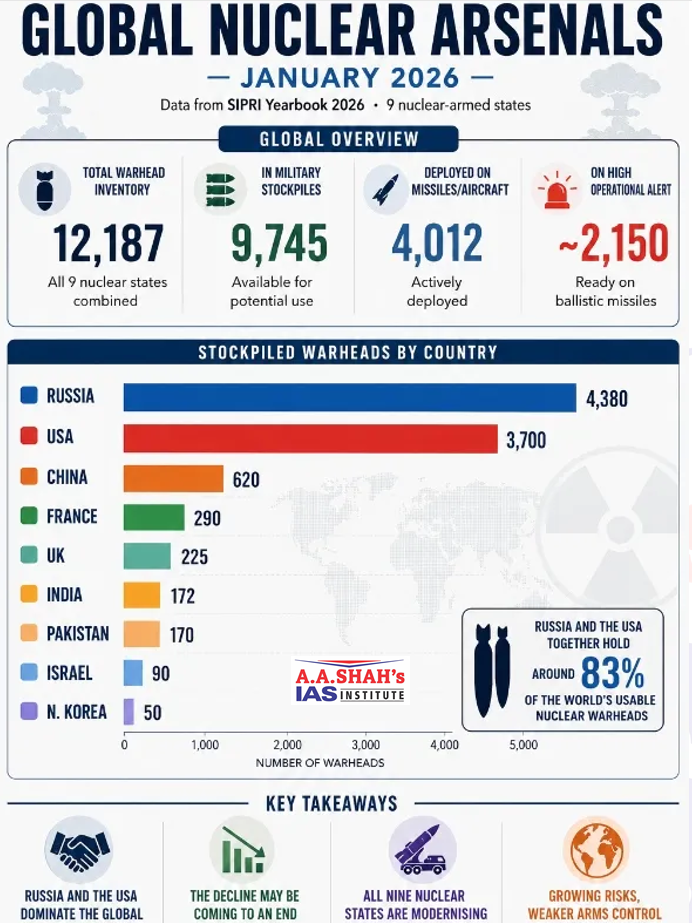
- As of January 2026, the world’s nine nuclear-armed states collectively possessed an estimated 12,187 nuclear warheads.
- China’s arsenal has grown to approximately 620 and continues to expand at a pace unmatched by any other nuclear power.
- In this context, India’s reported deployment of 12 operationally assigned warheads is strategically significant.