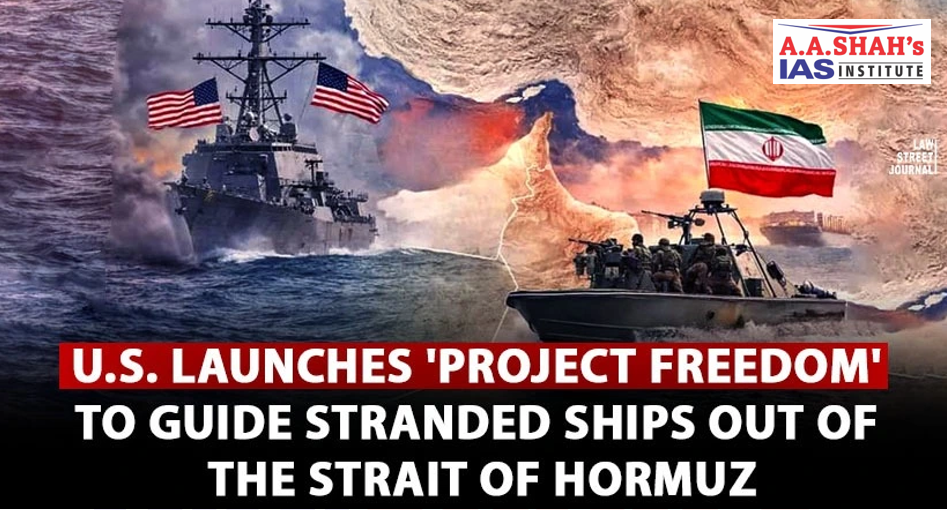
U.S. Project Freedom couldn’t secure free navigation
INTERNATIONAL – ASIA
9 MAY 2026
- The U.S. announced Project Freedom on May 4, 2026 to end the Iranian blockade of the Strait of Hormuz.
- It was suspended the next day even as merchant ships and U.S. Navy craft came under attack.
- Though U.S. President Donald Trump cited progress in talks with Iran as the reason for calling off the initiative, Iran showed it could escalate the situation if the U.S. persisted in its attempt to deny Iran stake in the Strait of Hormuz and establish dominance in the Persian Gulf.
- Listing a range of advanced systems, including underwater drones and warships, the U.S. said multiple advanced military capabilities were being ‘harnessed’ in Project Freedom to reopen safe navigation via the strait.
Operation Earnest Will, 1988
- This was a far cry from 40 years ago when, under the Operation Earnest Will, the U.S. was able to intervene in the Tanker Wars and ensure a relatively smoother flow of ships in the region.
- During Operation Earnest Will, the U.S. Navy escorted almost 130 fleets consisting of more than 250 ships in a 14-month period ending in September 1988.
- Though the Tanker Wars drove up insurance costs and reduced traffic, transits continued amid a few attacks and the strait remained open.
- After the U.S. launched a major operation against Iran’s Naval capabilities, Iran backed off and the Tanker Wars ceased.
- Now, however, some experts say drones have changed the equation. A few low-cost weapons could inflict visible damage on merchant ships and even one hit from a swarm of drones could have a disproportionate impact, including on insurance costs that influence global ship movements.