Daraxonrasib: pancreatic cancer drug shows promise
S&T – HEALTH
10 MAY 2026
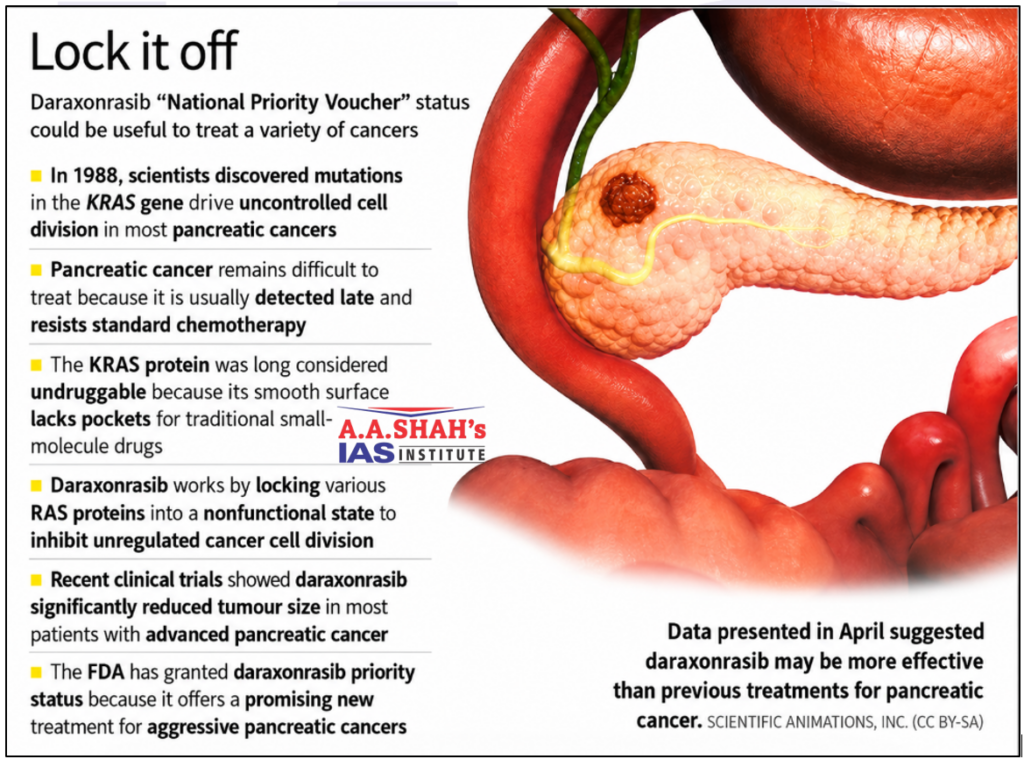
- In 1988, a landmark paper in Cell said that in around 95% of pancreatic cancers, a gene called KRAScarried mutations at a particular location.
- It was one of the first demonstrations of a mutation with near-universal frequency identified in a cancer.
Cancer
- Cancer is uncontrolled cell division.
- In a healthy individual, cells grow and divide in a tightly controlled cycle, with specific signals telling the cell when to divide or not.
- If something goes amiss in this process, cells can repair themselves or undergo programmed cell death.
- In cancer, this balance is disturbed, causing unregulated cell division. As a result, mistakes tend to accumulate in the DNA, leading to tumours that can invade surrounding tissues and spread to other organs.
- Pancreatic cancer is particularly deadly because it is usually detected late, when the disease has already spread to neighbouring tissues.
- There are very few surgical options; even after surgery, recurrence is common. Standard chemotherapy is also not very effective.
KRAS
- The 1988 Cell paper showed the KRAS gene acts as a switch, regulating whether a cell divides.
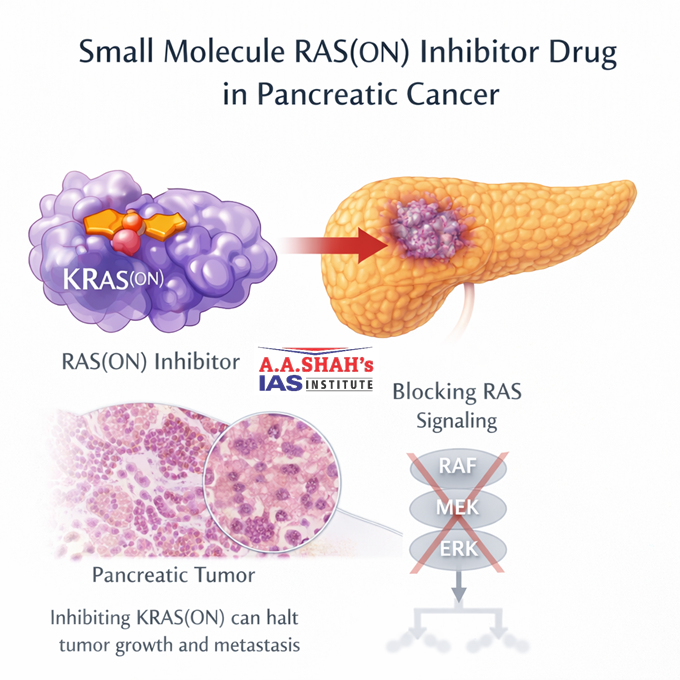
- The KRAS protein — the product of the gene — exists in either an ‘off’ state, which suppresses cell division or an ‘on’ state that promotes it.
- The mutations reported in the study locked KRAS in its ‘on’ state, driving uncontrolled cell division, leading to pancreatic, colorectal, and lung cancers.
- For decades, the medical fraternity considered KRAS to be an attractive drug target.
- However, it proved exceptionally difficult to inhibit because most small-molecule drugs work by fitting into well-defined pockets or grooves on a protein’s surface, blocking its activity, whereas KRAS has a relatively smooth, compact surface with few binding sites.
- Despite this difficulty, several research groups attempted to target the KRAS gene, but nearly all efforts fared poorly in clinical trials. As a result, KRAS was long labelled “undruggable”.
Daraxonrasib
- In June 2024, a California-based company called Revolution Medicines reported a molecule later called daraxonrasib. It works by targeting a range of the RAS family of proteins, including KRAS, when they are in their ‘on’ state and signalling the cell to divide.
- Daraxonrasib first binds to another protein called cyclophilin-A, then locking it with KRAS into a nonfunctional state.
- The clinical trial findings suggested daraxonrasib may be more effective than previous treatments for pancreatic cancer. In 51% of patients, it reduced the size of tumours, and in 97% it caused their cancers to either shrink or not grow further.
- However, daraxonrasib also had many side effects. Nearly all patients experienced mild to moderate effects, including skin rash, diarrhoea, mouth sores, nausea, and fatigue.
- However, importantly, no life-threatening side-effects were reported in any patients.
“National Priority Voucher” status
- The strong clinical results have also led the U.S. Food and Drug Administration (FDA) to include daraxonrasib among eight other therapies in the first-ever group of drugs to receive “National Priority Voucher” status.
- The FDA created this designation for highly promising drug candidates that address urgent national health needs.
- The voucher also allows the FDA to shorten what would typically be a year-long review process to just one or two months.
- The results of the FDA review are awaited as well, and there is growing optimism that it will be positive.