Monsoon deficit hits 40%; July outlook bleak
GEOGRAPHY
1 JULY 2026
- Rainfall in July – the most important of the monsoon months — will be “below normal” or less than 94% of what is usual for the month, Mrutyunjay Mohapatra, Director-General, India Meteorological Department (IMD), said.
- The outlook for July comes on the back of weak June rainfall where the shortfall was nearly 40% of what is usual for the month.
- The 99.5 mm received was the fifth lowest since 1901 and the least since 2014.
- “Below-normal rainfall can pose significant challenges for agriculture, water resources, hydropower generation, ecosystem sustainability, and drinking water availability,” the agency said in a statement.
- “Such conditions may increase the risk of heat stress, and pressure on available water resources in several regions.”
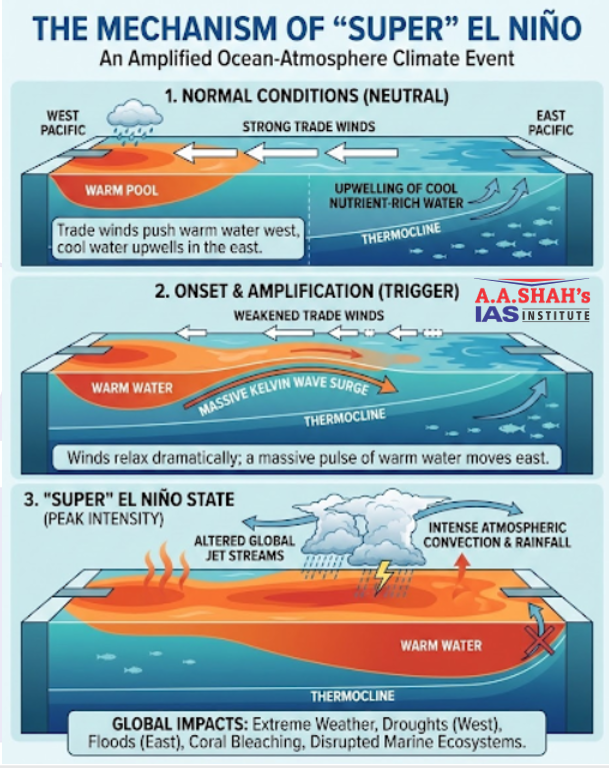
Super El Nino
- The El Niño that developed in June has negatively impacted rainfall.
- The monsoon deficits assume significance in a year that forecasters globally have warned of what will likely be a ‘Super El Niño’ year.
- This means an unusually hot Central Pacific through this peak period will only surface in winter – much after the southwest monsoon officially winds up by September-end.
- Six in 10 El Niño years translate to weak southwest monsoon rainfall.
Indian Ocean Dipole, or IOD
- Reputed weather models from the Australian Bureau of Meteorology have suggested that the Indian Ocean Dipole, or IOD, a climate pattern marked by changing sea surface temperatures between the western and eastern Indian Ocean that can strengthen or weaken India’s monsoon depending on its phase, could develop in the second of the monsoon (August and September) and, in theory, ameliorate the El Niño’s impact.
- “Our own models and several other reputable models show that the dipole will be ‘neutral,’ [meaning unhelpful].
- The 1997-98 El Niño year – one of the strongest in meteorological history – saw 2% more rain than was usual in India due to a favourable phase of the IOD.