Supreme Court’s judgment in Vanashakti vs Union of India
ENVIRONMENT – POLLUTION
21 AUGUST 2026
Mandatory Prior Environmental Clearance
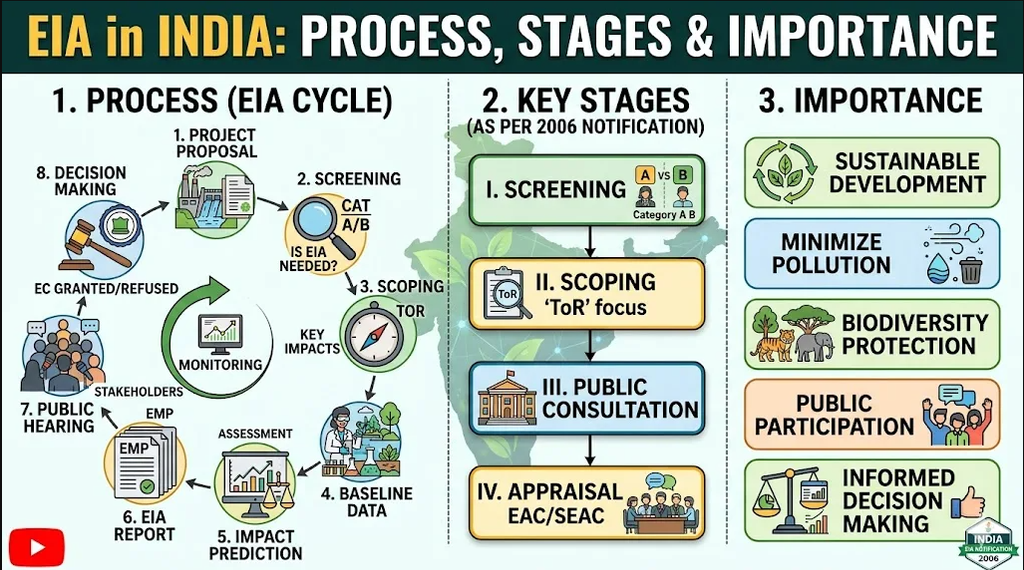
- The Supreme Court’s judgment of 29 July, 2026 reaffirmed that obtaining prior Environmental Clearance (EC) is mandatory under the Environmental Impact Assessment (EIA) Notification, 2006.
- Projects cannot legally begin construction or operations without obtaining the required EC beforehand.
- The judgment therefore strengthens the principle that environmental approval must be obtained before a project begins, rather than after the environmental damage or construction has already occurred.
End of Earlier Regularisation Mechanisms
- The Court held that projects that began construction or operations without prior EC and did not apply under the earlier violation mechanisms cannot now seek regularisation under the 2017 Notification or the 2021 Standard Operating Procedure (SOP).
- These earlier mechanisms are no longer available for fresh applications.
- Therefore, project proponents cannot use the old procedures to obtain post-facto approval for violations.
Government Can Create a Fresh Statutory Mechanism
- The Court clarified that the Central Government still has powers under Section 3 of the Environment (Protection) Act, 1986 to create a fresh statutory mechanism if it considers such action necessary in the larger public interest.
- This means that although the old regularisation mechanisms have been closed, the possibility of a new legally valid framework has not been completely ruled out.
- Any such mechanism would have to be created through a statutory notification under the authority granted by environmental legislation.
Difference Between an Office Memorandum and a Statutory Notification
- The Court distinguished between an administrative Office Memorandum and a statutory notification issued under the Environment (Protection) Act.
- An Office Memorandum cannot override the legal requirement of obtaining prior Environmental Clearance.
- However, a properly authorised statutory notification could potentially establish a new mechanism for dealing with specified violation cases.
- Such a mechanism would have to remain within the framework of environmental law.
Safeguards for Any Future Scheme
- The Court indicated that any future statutory mechanism should not become a permanent system of “violate first, regularise later.”
- A future mechanism would have to be strictly one-time and based on proper statutory authority.
- It should include measures such as assessment of environmental damage, environmental remediation and payment of environmental compensation.
- Projects receiving such an opportunity would also have to satisfy strict environmental compliance conditions.