Centre set to expand National Action for Mechanised Sanitation Ecosystem (NAMASTE) scheme to rural India
SOCIAL – SCHEMES
21 AUGUST 2026
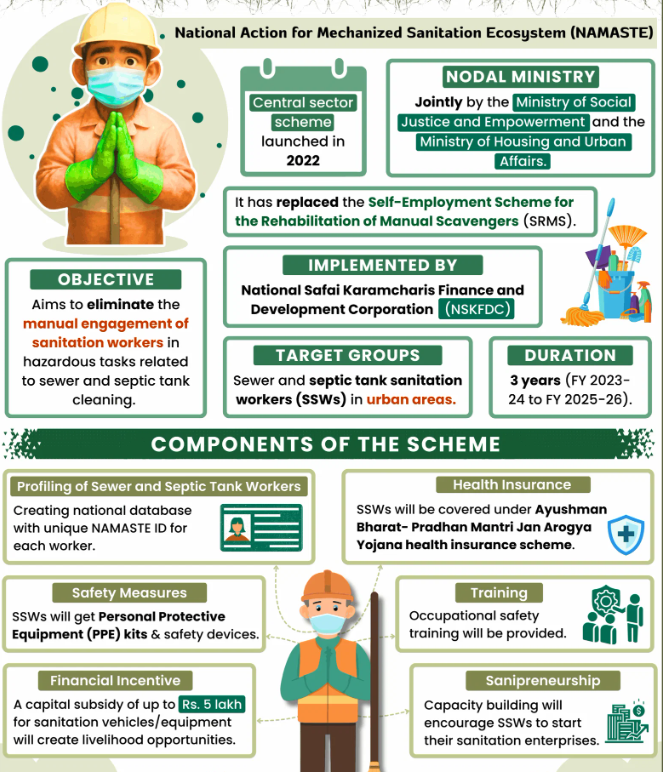
- The government is planning to expand the National Action for Mechanised Sanitation Ecosystem (NAMASTE) scheme from urban areas to rural parts of the country.
- The scheme was launched in 2023–24 with the objective of preventing deaths caused by the hazardous cleaning of sewers and septic tanks.
- The expanded scheme is intended to cover drain cleaners, sewage treatment plant workers and faecal sludge treatment plant workers.
- The government has proposed an expenditure of around ₹498.73 crore from the current financial year to 2030–31.
Continued Deaths During Hazardous Sanitation Work
- The Social Justice Ministry informed Parliament that 498 people died across India while engaged in hazardous sewer and septic tank cleaning between 2019 and June 2026.
- These deaths highlight the continuing dangers faced by workers involved in hazardous sanitation activities.
Expansion to Waste Pickers
Financial Assistance and Other Benefits
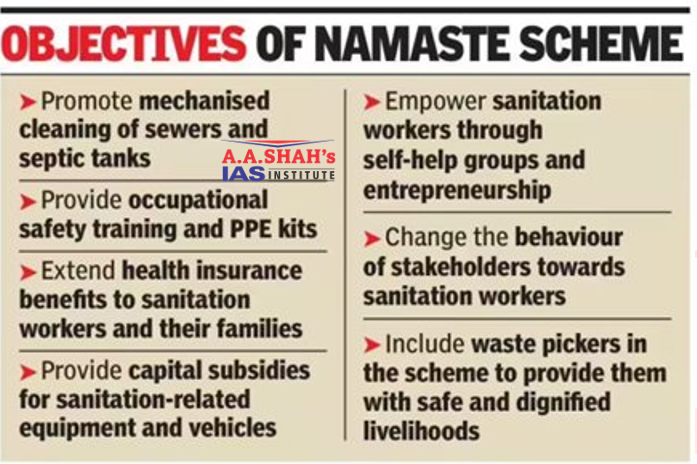
- The NAMASTE scheme, initially focused on sewer and septic tank workers (SSWs), was later expanded to include waste pickers.
- According to the Ministry’s 2025–26 annual report, 90,915 SSWs and around 1.3 lakh waste pickers have been profiled under the scheme.
- The scheme provides capital subsidies of up to 50% of the total project cost to help eligible workers establish their own sanitation-related enterprises.
- The scheme also supports the establishment of Emergency Response Sanitation Units in urban local bodies.
- Profiled workers are provided with training workshops and personal protective equipment (PPE) to improve their safety and skills.
Low Number of Capital Subsidy Approvals
- Despite the scheme’s objectives, only 810 sewer and septic tank workers had been approved for capital subsidies by March 31, 2026.
- Of these 810 approved workers, only 147 had actually received the subsidy funds by that date.
- The limited number of approvals and actual disbursements has raised concerns about the effectiveness of the scheme.
Limited Approval of Projects for Manual Scavengers
- Only 2,652 projects had been approved for the approximately 58,000 manual scavengers identified under the scheme.
- These projects include proposals submitted by Private Sanitation Service Organisations (PSSOs) as well as individual beneficiaries.
- The low number of approved projects indicates that many eligible workers have not yet been able to benefit from the scheme.
NCSC Raises Concerns Over Rejections
- The National Commission for Scheduled Castes (NCSC) has repeatedly raised concerns about the large number of applications being rejected under the scheme.
- The NCSC has informed the Social Justice Ministry that rejections under different components of the capital subsidy programme may be one of the reasons for the low number of approved projects.
- The Commission has asked the government to examine the reasons for these rejections.
Rejections Under Self-Employment Components
- In an August 2025 letter, the NCSC specifically highlighted rejections under the self-employment components of the NAMASTE scheme.
- The concerns included rejections under the Safai Udyami Yojana, through which sewer and septic tank workers can receive capital subsidies.
- The NCSC also raised concerns about rejections involving Private Sanitation Service Organisations (PSSOs).