Chemistry Nobel for French-Japanese duo who expanded ‘mirrored’ molecules study
S&T – BIOTECHNOLOGY / AWARDS
8 OCTOBER 2026
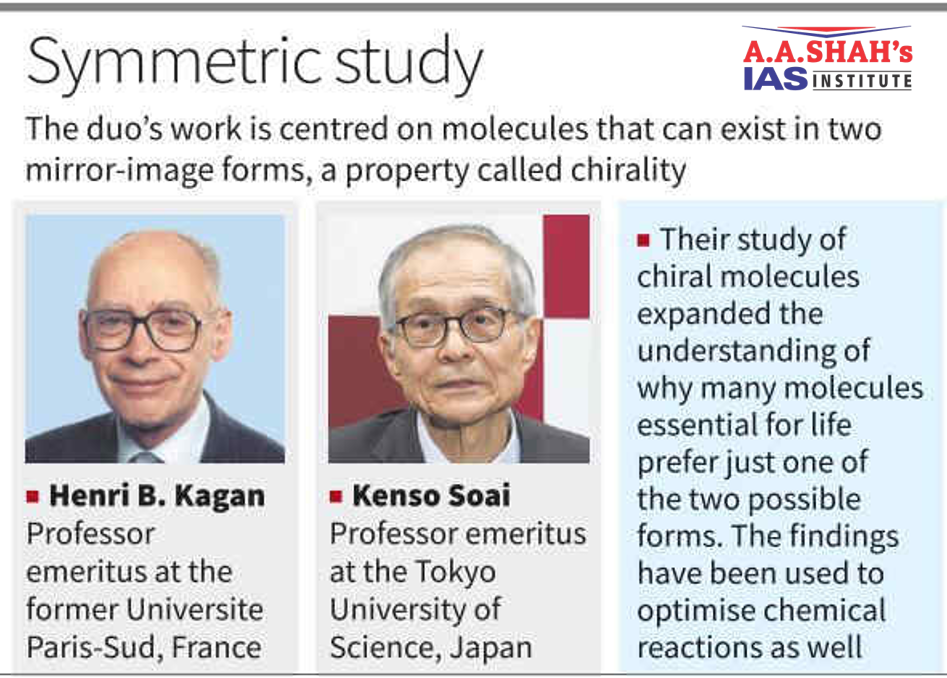
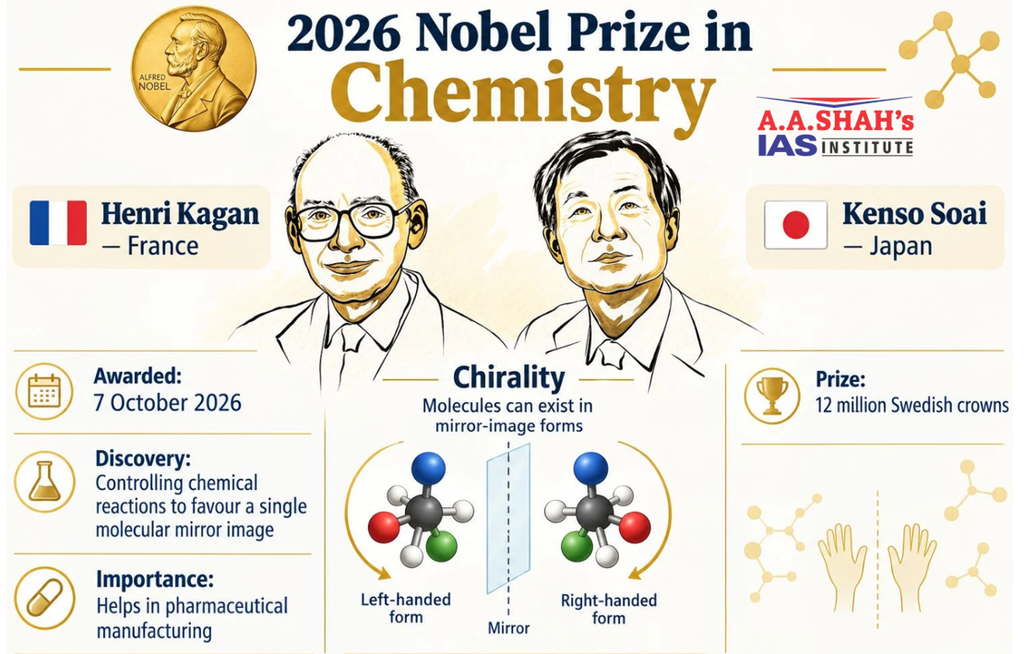
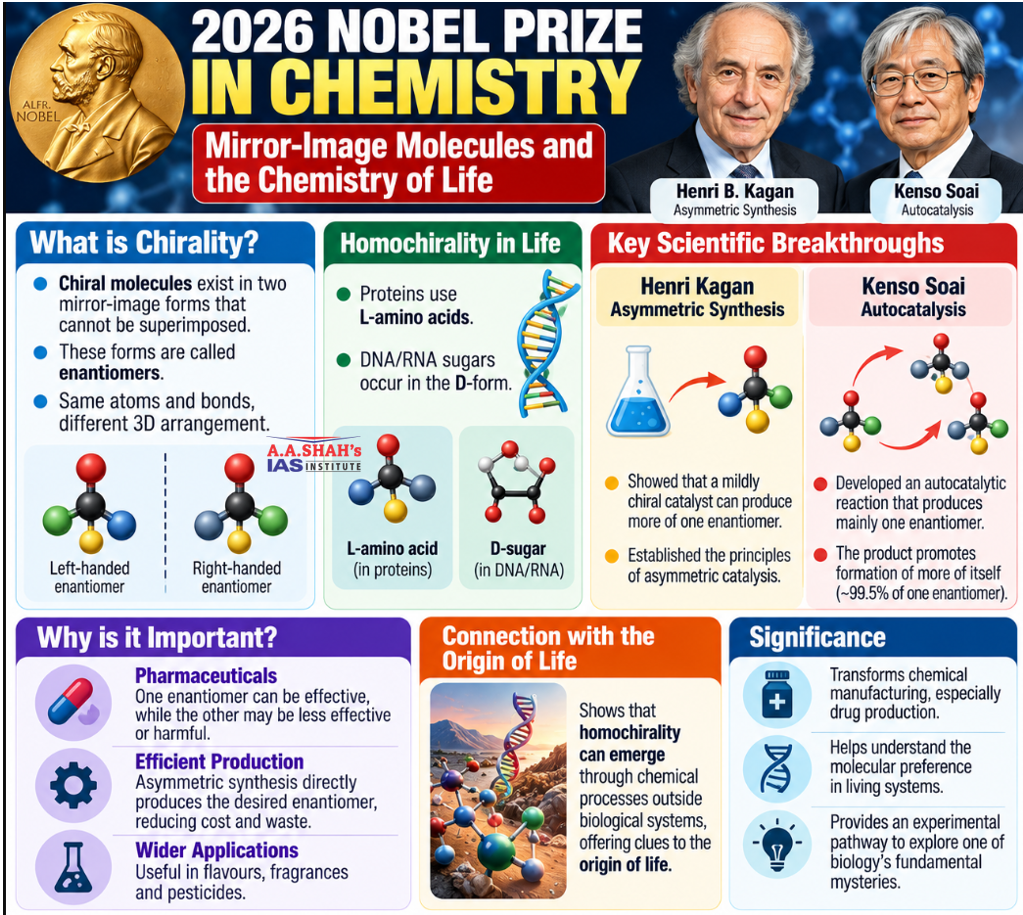
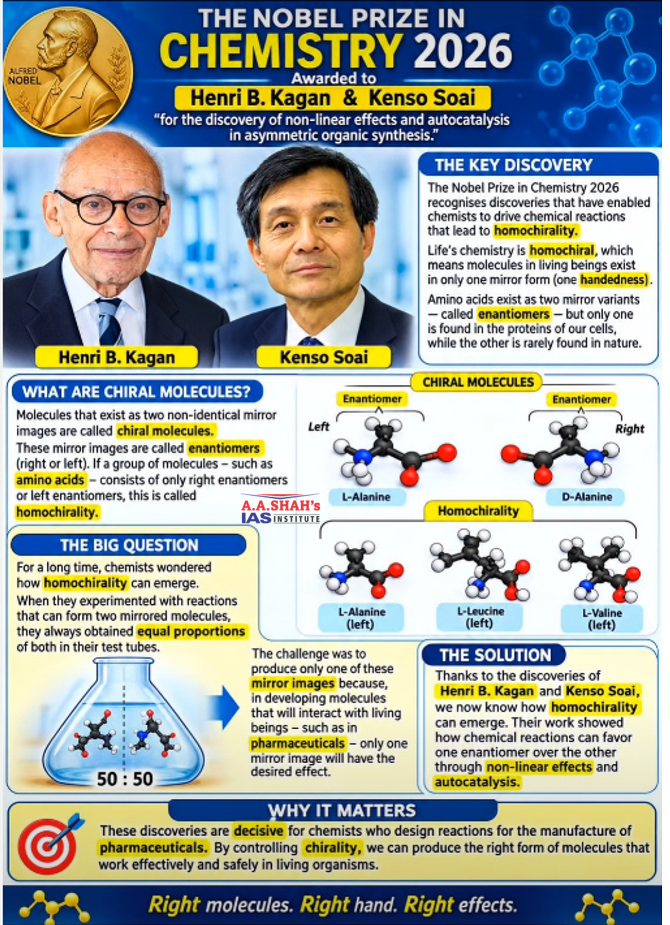
- French chemist Henri Kagan and Japanese chemist Kenso Soai were named the winners of the chemistry Nobel Prize for 2026 for their work showing how chemical reactions can amplify small asymmetries in molecules.
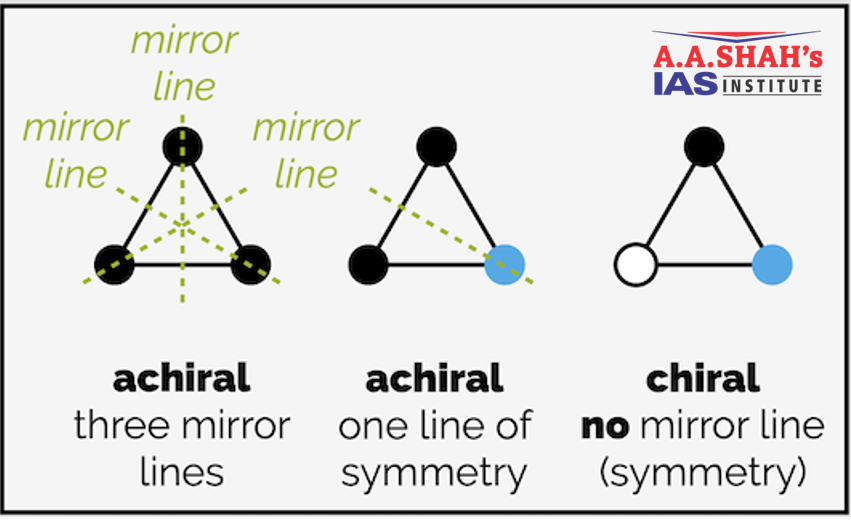
- Their work centred on chiral molecules, which are molecules that can exist in two mirror-image forms, like a left and a right hand, called enantionmers.
- Chirality is a geometric property where an object or molecule cannot be superimposed on its mirror image, similar to how a left hand does not fit onto a right hand.
- They solvedone of chemistry’s greatest mysteries: how molecular “handedness” (chirality) can arise, amplify, and dominate chemical reactions.
- Professor Kagan’s work paved the way for scientists to tune chemical reactions to produce the desirable forms of drugs, agrochemicals, and fragrances.
What is Molecular Handedness (Chirality)?
- Just like your left and right hands are mirror images that cannot be superimposed on each other, many molecules exist in two mirror-image forms called enantiomers.
- The Mystery: When chemists synthesize molecules in a lab from non-chiral starting materials, they almost always get a 50/50 mixture (a racemic mix) of left- and right-handed molecules.
- Life’s Single-Handedness (Homochirality): Biological life is exclusively lopsided. Virtually all amino acids in proteins are left-handed, while the sugars in DNA and RNA are right-handed. For over a century, scientists couldn’t explain how nature broke this symmetry—or how a tiny initial imbalance could grow to make all of life “one-handed”.
The Breakthrough Discoveries
- The 2026 Nobel laureates provided the mechanisms explaining how a minuscule imbalance in handedness gets exponentially magnified:
1. Henri B. Kagan: Non-Linear Amplification
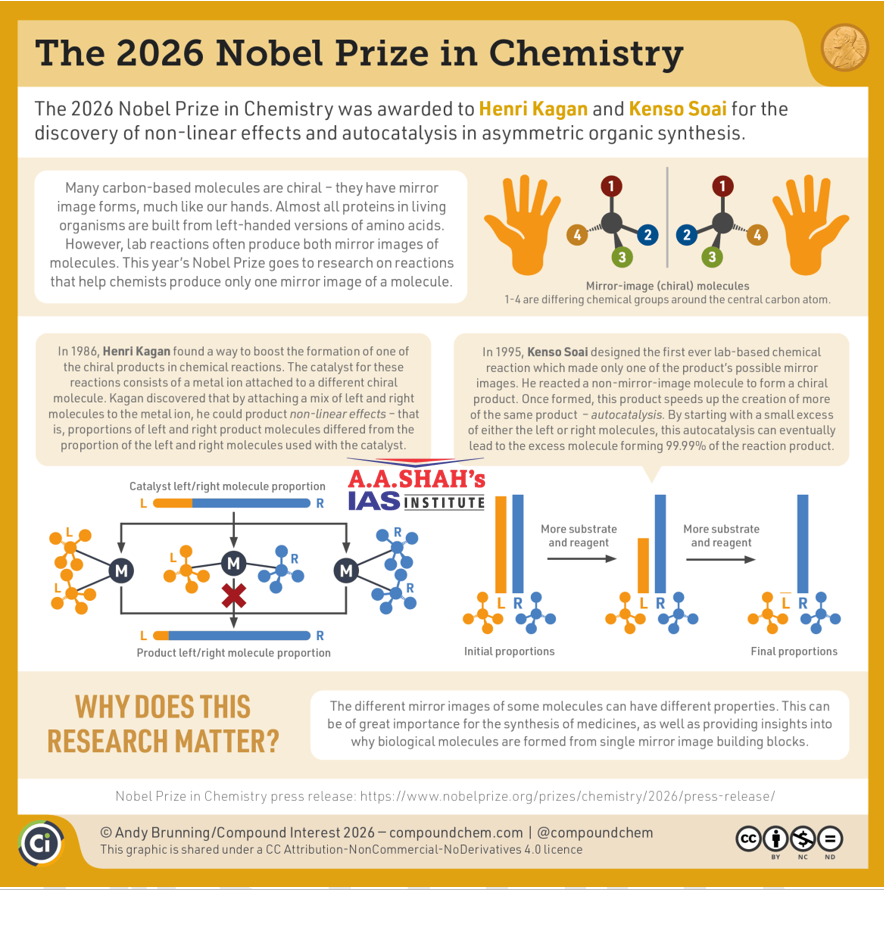
- In 1986, Kagan challenged a long-held assumption in chemistry: that a catalyst with a small excess of one handedness would only yield products with that same small excess. He proved that through non-linear effects, a catalyst that is only slightly biased toward one hand can produce products with massive purity in that same hand. Chemistry doesn’t just copy handedness; it amplifies it.
2. Kenso Soai: Asymmetric Autocatalysis (The Soai Reaction)
- In the 1990s, Soai discovered a reaction where a chiral molecule acts as its own catalyst—a process called autocatalysis.
- In the Soai reaction, a tiny trace—or even random chance fluctuations in a non-chiral mixture—causes one enantiomer to start replicating itself.
- The molecule reproduces its own handedness exponentially until the final product is virtually 100% single-handed. This was the first time scientists created extreme homochirality from non-chiral starting materials in a lab.
Why Handedness Matters
- Understanding and controlling molecular handedness is critical, particularly in pharmaceuticals:
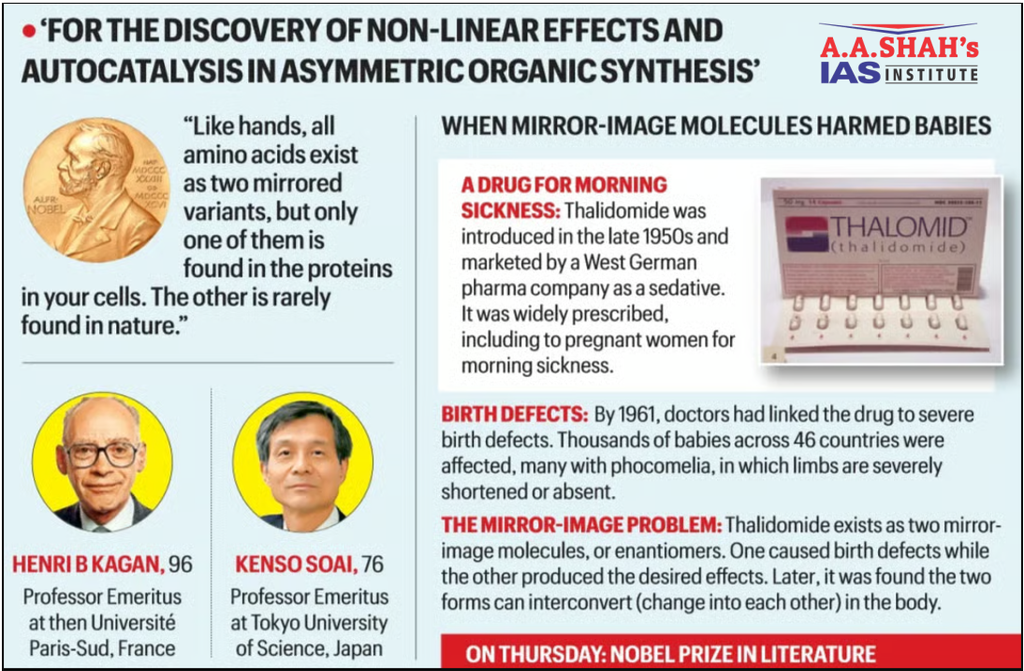
- The human body’s biological receptors are single-handed, meaning two mirror-image forms of the same drug can have drastically different effects.
- One enantiomer might be a safe medication, while its mirror image could be completely inactive, toxic, or carry unintended side effects.
- Kagan and Soai’s work gave chemists the fundamental rules and tools to design catalysts that produce exclusively the desired “handed” form of a drug.