Ease three-language rule for Class 6, SC tells CBSE
SOCIAL – EDUCATION
21 AUGUST 2026
One-Time Relief for Class 6 Students
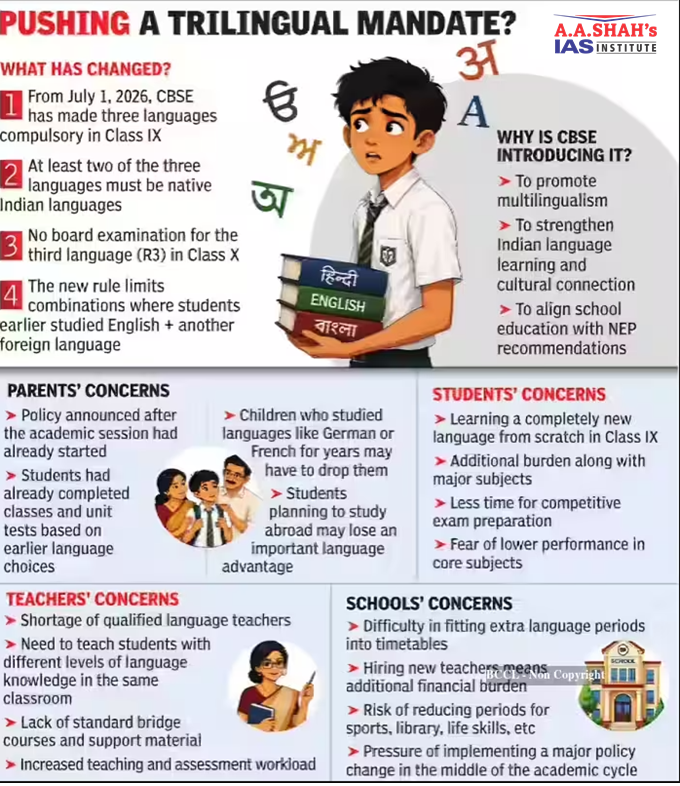
- The Supreme Court asked the CBSE to consider giving the current Class 6 students a one-time exemption from appearing for the mandatory third-language examination in Class 10.
- The Court questioned why these students should be required to take the third-language Board examination when the policy is being introduced for the first time for their batch.
- The Court wanted CBSE to provide students with some time to adjust to the new language requirements.
Gradual Implementation of the Policy
- Justice Bagchi suggested a system in which students could learn their mother tongue, another Indian language and an additional Indian or foreign language.
- The Supreme Court suggested that the three-language policy should be introduced gradually rather than being imposed suddenly on students.
- The Court suggested that language learning could begin in earlier classes, when children are younger and have more time to adapt.
Need for Adequate Infrastructure
- The Court pointed out that the successful implementation of the policy would require adequate teachers, textbooks and other educational resources.
- It stated that the necessary infrastructure should be developed across different education Boards before the policy is fully implemented.
- CBSE was asked to consider how it would develop the human resources required to teach three languages effectively.
Concern About Foreign Languages
- Lawyers opposing the policy argued that treating English as a foreign language could reduce the opportunity for students to study other foreign languages.
- They pointed out that students who choose English as their additional language may have little opportunity to study languages such as French, Japanese or Spanish.
- They argued that learning an additional foreign language could provide students with greater educational and employment opportunities.
Status of English
- The petitioners argued that the policy effectively places English alongside other foreign languages such as French, Japanese and Spanish.
- Chief Justice Surya Kant observed that English could hardly be considered a foreign language in the Indian context.
- The CBSE’s representative stated that English is an official language under the Constitution, although it is not considered a native Indian language.
- She also emphasised that language serves as a vehicle for transmitting culture.