Large Hadron Collider (LHC) of CERN
S&T – PHYSICS
14 JUNE 2026
- CERN (Conseil Européen pour la Recherche Nucléaire) is the world’s largest particle physics laboratory established in 1954 near Geneva in Switzerland.
Objectives of CERN
- To study the fundamental particles that make up matter.
- To understand the fundamental forces of the universe.
- To conduct high-energy particle collision experiments.
Large Hadron Collider (LHC)
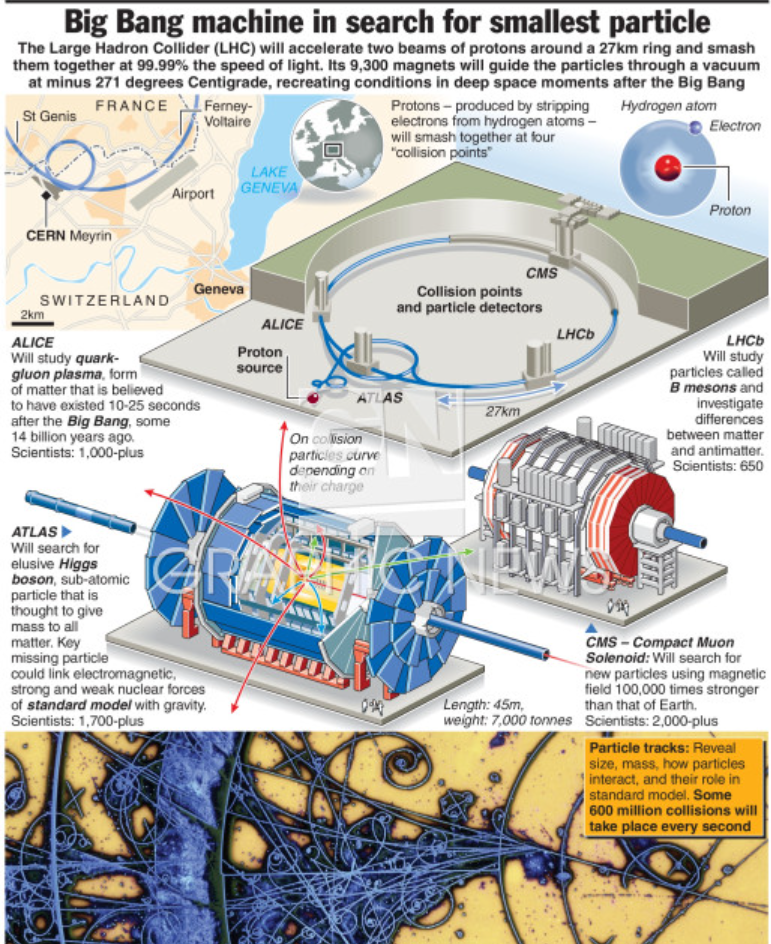
- CERN operates the Large Hadron Collider, the world’s largest and most powerful particle accelerator.
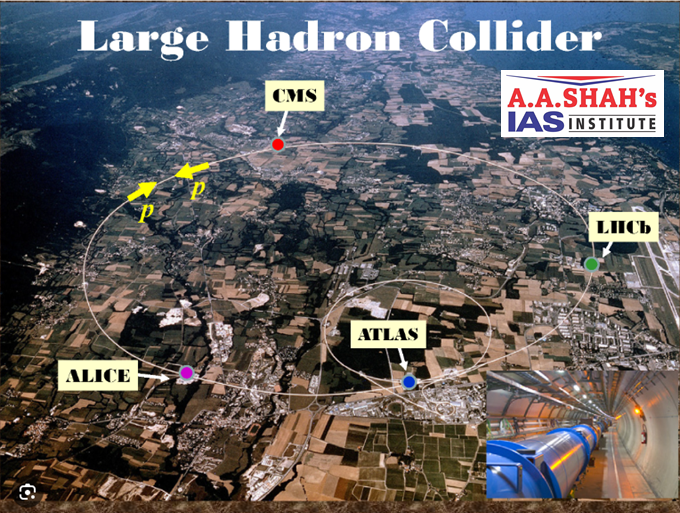
- It is a circular tunnel about 27 km long located underground.
- Protons are accelerated to near the speed of light and made to collide.
- Experiments at CERN include ATLAS, CMS, ALICE and LHCb
- Theystudy particle collisions to understand matter, antimatter, dark matter, and conditions that existed just after the Big Bang.
Major Discoveries
- CERN scientists discovered the Higgs Boson in 2012.
- This confirmed the Higgs mechanism, which explains how elementary particles acquire mass.
- The discovery led to the 2013 Nobel Prize in Physics for Peter Higgs and François Englert.
India and CERN
- India became an Associate Member of CERN in 2017.
- Indian scientists and institutions contribute to CERN experiments, detector development, computing, and data analysis.
- Several Indian research organisations, including Bhabha Atomic Research Centre (BARC) and Tata Institute of Fundamental Research (TIFR), collaborate with CERN.