Standard Model of Particle Physics
S&T – PHYSICS
14 JUNE 2026
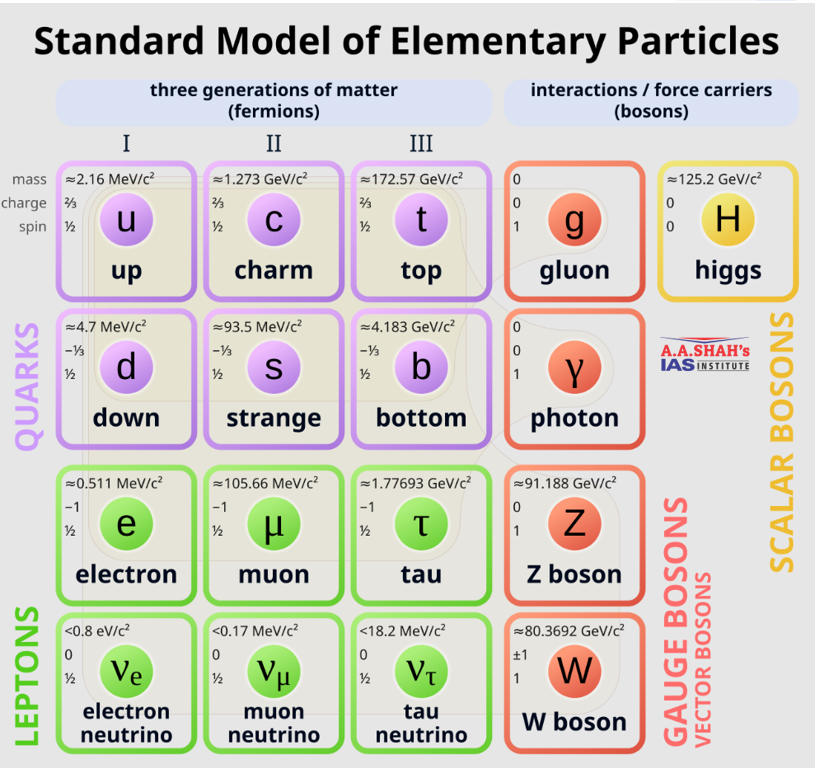
- The Standard Model of Particle Physics is the most successful theory for explaining the fundamental building blocks of matter and the forces acting between them.
- Developed in the 1970s, it describes all known elementary particles and explains three of the four fundamental forces of nature: electromagnetic, weak, and strong interactions.
- The fourth fundamental force is gravitational force.
Fundamental Particles of the Universe
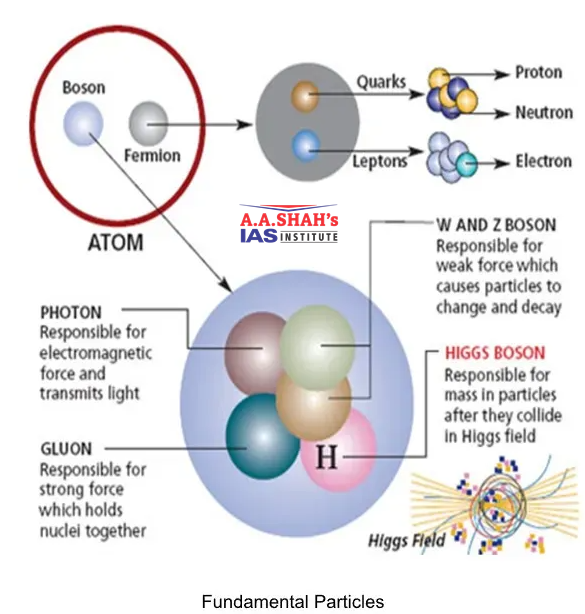
- According to the Standard Model, all matter is made up of two categories of elementary particles: fermions and bosons.
- Fermions constitute matter, while bosons act as carriers of fundamental forces.
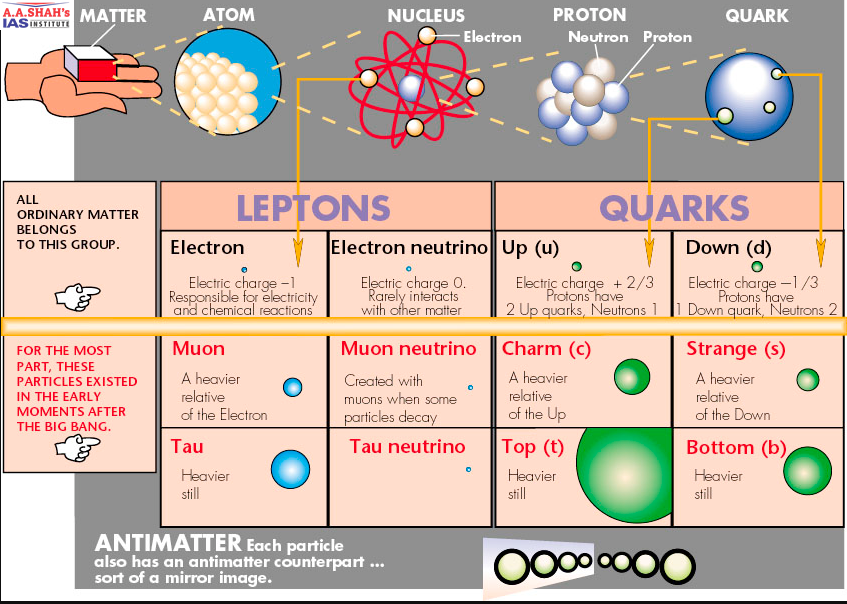
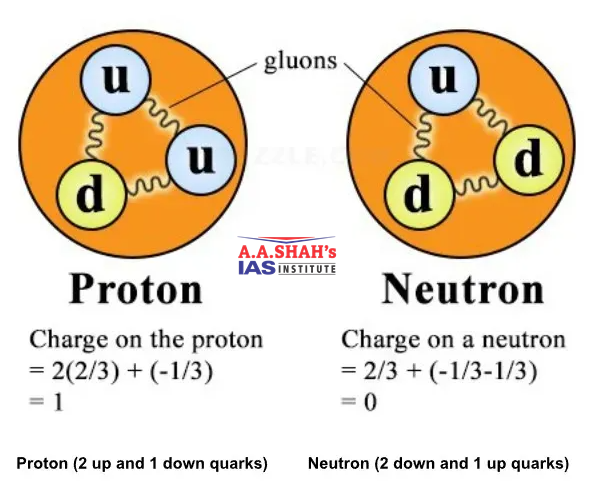
- Atoms consist of electrons orbiting a nucleus made of protons and neutrons. Protons and neutrons are themselves composed of smaller particles called quarks.
Fermions: The Building Blocks of Matter
- Fermions are the particles that make up all ordinary matter in the universe.
- They obey the Pauli Exclusion Principle, which states that no two identical fermions can occupy the same quantum state simultaneously.
- Fermions are divided into two groups: quarks and leptons.
Quarks
- Quarks are fundamental particles that possess colour charge and therefore interact through the strong nuclear force.
- There are six types or “flavours” of quarks: Up, Down, Charm, Strange, Top, Bottom
- Quarks combine to form composite particles known as hadrons.
Leptons
- Leptons are fundamental particles that do not possess colour charge and therefore do not participate in strong nuclear interactions.
- There are six leptons:
Charged Leptons: Electron, Muon andTau
Neutral Leptons : Electron neutrino, Muon neutrino and Tau neutrino
- Unlike quarks, leptons do not combine to form larger composite particles.
Combination of Quarks and Leptons
Baryons
- Baryons are particles made up of three quarks.
- Protons and neutrons are the most common examples of baryons.
Mesons
- Mesons are particles made up of a quark and an antiquark.
- Unlike baryons, mesons behave as bosons because they possess integer spin.
- Quarks can change from one flavour to another through the weak force mediated by W and Z bosons.
Neutrinos: Ghost Particles
- Neutrinos are extremely light and weakly interacting leptons often called “ghost particles.”
- They are produced in nuclear fusion inside stars, nuclear reactors and in radioactive decay processes
- Neutrinos can change from one type to another through a phenomenon called neutrino oscillation, which demonstrates that neutrinos possess mass.
- The India-based Neutrino Observatory (INO) is a proposed underground neutrino research facility planned at Pottipuram in Theni district, Tamil Nadu, to study neutrinos and their properties.
Bosons: The Force Carriers
- Bosons are particles that carry forces between fermions.
- Unlike fermions, multiple bosons can occupy the same quantum state simultaneously.
- They obey Bose-Einstein statistics, developed by Satyendra Nath Bose and Albert Einstein.
- Under certain conditions, bosons can form a special state of matter known as a Bose-Einstein Condensate.
Gauge Bosons (Force-Carrying Bosons)
- Each fundamental force is mediated by a specific boson.
- These particles transfer forces between matter particles.
| Force | Carrier Boson |
| Electromagnetic Force | Photon |
| Strong Nuclear Force | Gluon |
| Weak Nuclear Force | W Boson and Z Boson |
Higgs Boson (God Particle)
- The Higgs Boson is associated with the Higgs field, which exists throughout the universe.
- Particles acquire mass through their interaction with this field. The stronger a particle interacts with the Higgs field, the greater its mass.
- The Higgs boson was experimentally discovered in 2012 at CERN, confirming a major prediction of the Standard Model.
Graviton (Hypothetical Particle)
- Physicists hypothesise the existence of a particle called the graviton, which would carry the gravitational force.
- However, no graviton has yet been discovered, and gravity is therefore not included in the Standard Model.
Major Features of the Standard Model
- Unified Description of Matter and Forces
The Standard Model provides a unified framework for understanding how fundamental particles interact through electromagnetic, weak, and strong forces.
2. Prediction of New Particles
One of the greatest strengths of the Standard Model is its ability to predict particles before their experimental discovery.
Its predictions successfully led to the discovery of various quarks, neutrinos, W and Z bosons and Higgs boson
3. Foundation of Modern Particle Physics
Since the 1970s, the Standard Model has served as the theoretical foundation of high-energy physics and has been repeatedly validated through experiments.
Limitations of the Standard Model
Gravity is Not Included
The Standard Model explains only three of the four fundamental forces and does not incorporate gravity.
The absence of an experimentally confirmed graviton remains a major gap in the theory.
- Dark Matter and Dark Energy Remain Unexplained
- The Standard Model does not explain the nature of dark matter and dark energy, which together constitute approximately 95% of the universe.
- Origin of Particle Quantum Numbers
- The theory does not explain why particles possess specific properties such as electric charge, weak isospin, hypercharge, and colour charge.
- Mass of Composite Particles
- The Standard Model cannot fully explain why composite particles such as protons have masses much larger than the combined masses of their constituent quarks.
- Mass of Neutrinos
- Although neutrinos are known to possess mass because of neutrino oscillations, the Standard Model does not adequately explain how they acquire this mass.