NHPC’s own paper detailed gas fires in Teesta-VI tunnels before fatal blast
DISASTER MANAGEMENT
23 JULY 2026
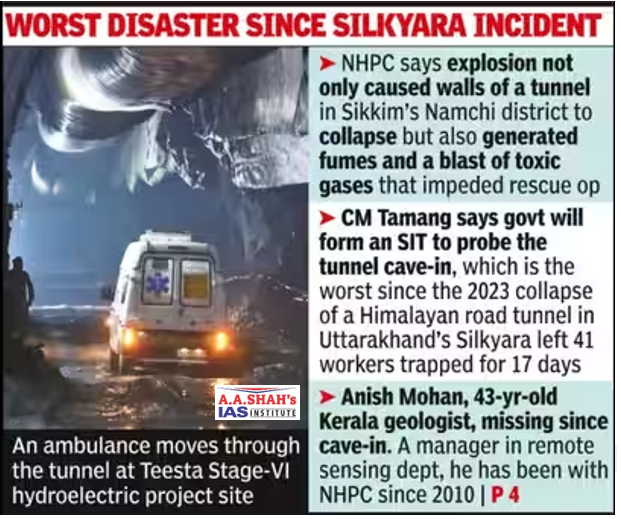
- Flammable gas had been encountered repeatedly, and had caught fire more than once inside the headrace tunnels of the Teesta VI Hydroelectric Project (500MW), Sikkim, in the years before the explosion, suspected to be from release of methane, which killed at least 15 workers on 20th July 2026.
- The NHPC has said the 20 July 2026 explosion followed a “sudden burst of suspected methane gas” struck during work about 1.5 km inside the tunnel at the Samardung site in Sikkim’s Namchi district, and has announced a detailed investigation.
- About 25 workers were inside when the blast triggered a landslide that sealed the tunnel, and rescue operations are continuing this week.
Technical Paper on geological difficulties in the project
- A technical paper written by the National Hydroelectric Power Corporation Limited’s (NHPC) own engineers in 2024 and presented at EUROENGEO 2024, the 4th European Regional Conference of the International Association for Engineering Geology, at Dubrovnik, Croatia, sets out the geological difficulties faced in completing the 500 MW project’s two headrace tunnels, each about 13.7 km long.
- A headrace tunnel is the component that purveys water from a source to an electric plant’s turbines.
- According to the paper, “flammable gas” was first detected in November 2009, during excavation by the project’s original developer, at a tunnel face where it “burst into flame”.
- The paper also catalogues extensive instability along the tunnels.
Restarting the project
- When the NHPC restarted excavation in 2021, after the project had stood idle for roughly nine years, it found many stretches built by the previous developer had collapsed, with cave-ins in places reaching the surface, and the access adits flooded.
- Teesta-VI was absorbed by the public-sector NHPC Limited after its private developers, unable to afford escalating costs, went into insolvency.
Teesta –III disaster 2023
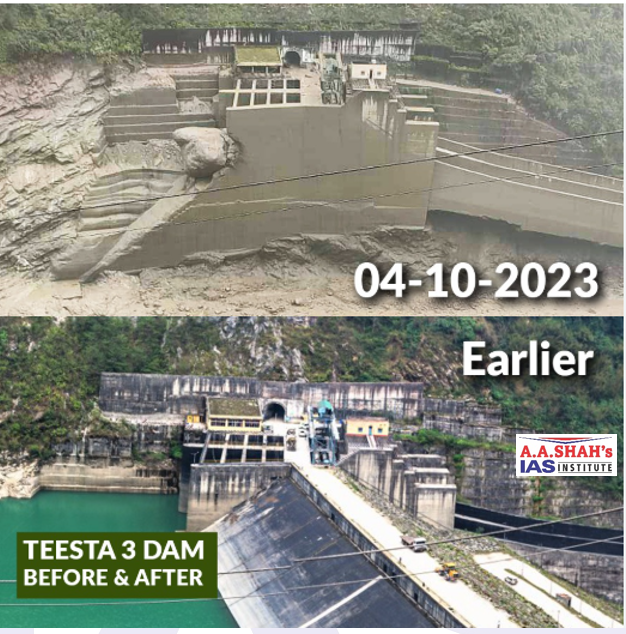
- The project lies in the fragile Himalayan belt and that vulnerability was demonstrated tragically in October 2023, when a Glacial Lake Outburst Flood (GLOF) from the South Lhonak lake destroyed the Teesta-III dam and killed more than a 100 people downstream.
Glacial Lake Outburst Flood (GLOF)
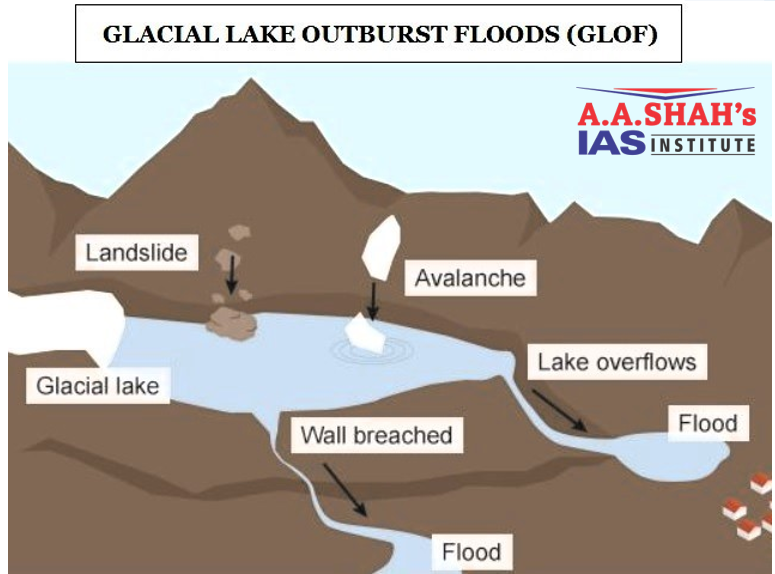
- A Glacial Lake Outburst Flood (GLOF) occurs when a moraine or ice dam containing a glacial lake suddenly fails, releasing massive volumes of water.
- In the Himalayas, these are frequently triggered by avalanches, earthquakes, or heavy rains, sending destructive flash floods downstream with little warning.