Govt. clarifies on FCRA Bill’s designated authority clause
POLITY- BILL/ACT
23 JULY 2026
- Amid concerns raised by minority institutions, particularly the Christian bodies, against the Foreign Contribution (Regulation) Amendment Bill, 2026 (FCRA), the Press Information Bureau (PIB) said that the designated authority would retain the religious character of places of worship.
- One key provision in the FCRA Bill, 2026, which was introduced in the Lok Sabha on March 25, 2026 but could not be passed following an uproar by the Opposition parties, is the appointment of a ‘designated authority’ to take over, manage, or dispose of assets created from foreign funds when an NGO’s FCRA registration is suspended, cancelled, or not renewed.
- This authority will have the powers of a civil court and can order the transfer or sale of assets owned by NGOs to the government or any other body.
- The Bill is listed for passage in the ongoing monsoon session of the Parliament.
- Responding to another “myth” that cancellation of FCRA registration always means the organisation has done something wrong, the PIB said, “Not necessarily. Many cancellations and non-renewals are administrative, arising from non-filing of annual returns, non-renewal before expiry, or failure to maintain designated accounts. The courts remain fully empowered to review any cancellation.”
FCRA (Foreign Contribution Regulation Act), 2010
- FCRA is an Indian law that regulates the acceptance and utilization of foreign contributions (donations) and foreign hospitality by certain individuals, associations, companies, and NGOs.
- It is administered by the Ministry of Home Affairs (MHA).
- The objective is to ensure that foreign funds are not used in a manner detrimental to India’s sovereignty, national security, public interest, or democratic institutions.
- It replaced the FCRA (Foreign Contribution Regulation Act), 1976
Objectives
- Regulate the receipt of foreign donations.
- Ensure transparency and accountability in the use of foreign funds.
- Prevent foreign influence in political, electoral, or other activities against national interest.
Who Can Receive Foreign Contribution?
- Registered NGOs, trusts, societies, and Section 8 companies. They must obtain either:
- FCRA Registration (for regular foreign contributions), or
- Prior Permission (for a specific contribution from a specific donor).
Who Cannot Receive Foreign Contribution?
- Election candidates
- Members of Parliament and State Legislatures
- Political parties and office-bearers
- Judges
- Government/public servants
- Editors, publishers, or owners of newspapers and certain media organizations
Major 2020 Amendments
- Foreign contributions must be received only in a designated State Bank of India, New Delhi Main Branch FCRA account.
- Transfer of foreign contributions to another FCRA-registered organization was prohibited.
- Administrative expenses capped at 20% (reduced from 50%).
- Aadhaar made mandatory for key functionaries (or passport/OCI for foreigners).
- Government empowered to suspend utilization of unutilized foreign funds under certain circumstances.
Amendments proposed in 2026
- The Foreign Contribution (Regulation) Amendment Bill, 2026 was introduced in the Lok Sabha on 25 March 2026.
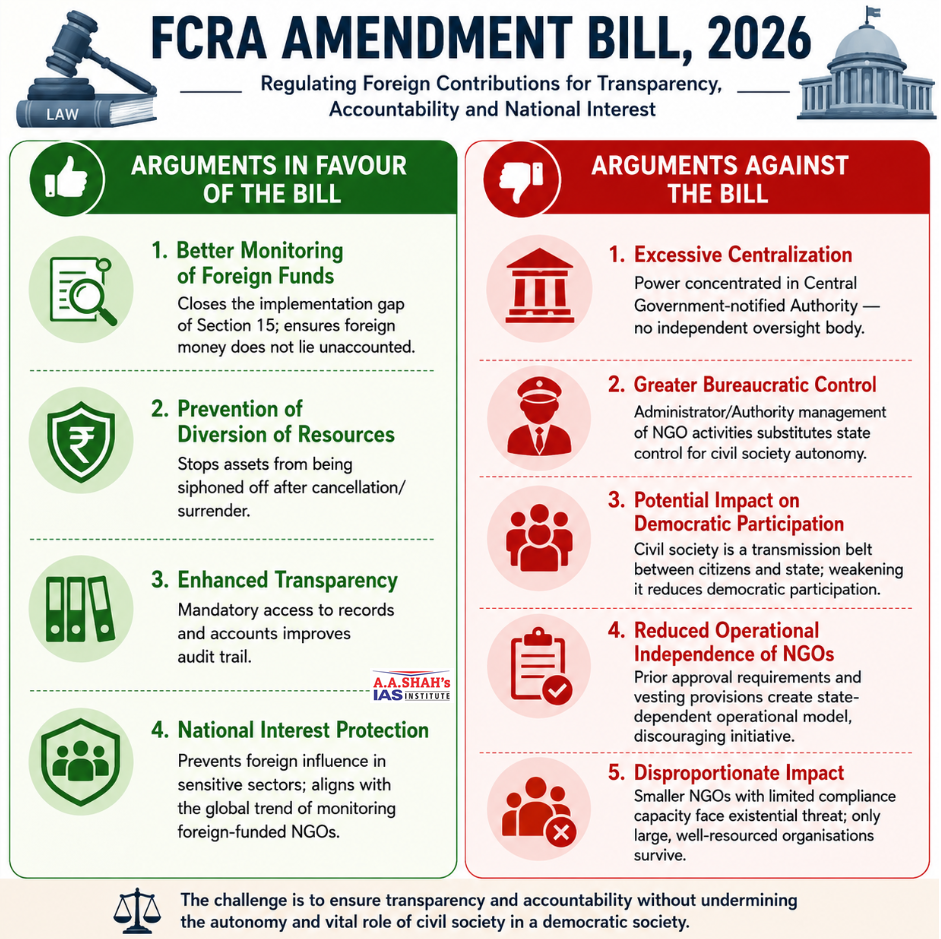
- It proposes to strengthen government oversight over foreign contributions and the assets created from them, particularly when an organisation’s FCRA registration ceases.
- These proposals have generated debate over balancing national security with the autonomy of civil society organizations.
Key Proposed Amendments (2026)
| Provision | Existing Position | Proposed Amendment (2026) |
| 1. Designated Authority | No permanent statutory authority for managing assets after cancellation of registration. | A Designated Authority will supervise, manage, and dispose of foreign contributions and assets when an organisation’s FCRA certificate ceases. It will have the powers of a civil court and can order the transfer or sale of assets owned by NGOs to the government or any other body. |
| 2. Vesting of Assets | No detailed mechanism for assets after cancellation/surrender. | Foreign-funded assets and unutilised foreign contributions will vest in the Designated Authority if the organisation’s certificate is cancelled, surrendered, expires without renewal, or renewal is refused. |
| 3. Religious Places | No explicit statutory provision. | If the vested asset is a place of worship, the Designated Authority must preserve its religious character. |
| 4. Prior Permission | No statutory timeline for receipt and utilisation. | Prior permission will be valid only for a specified purpose, amount, and prescribed time period. |
| 5. Suspension Period | Restrictions mainly on utilisation of funds. | Organisations under suspension will also face restrictions on dealing with foreign-funded assets. |
| 6. Penalties | Maximum imprisonment up to 5 years for certain offences. | Proposal to reduce maximum imprisonment to 1 year while rationalising penalties and strengthening administrative enforcement. |