Pegasus to rescue Swift Observatory space telescope
S&T – SPACE
1 JULY 2026
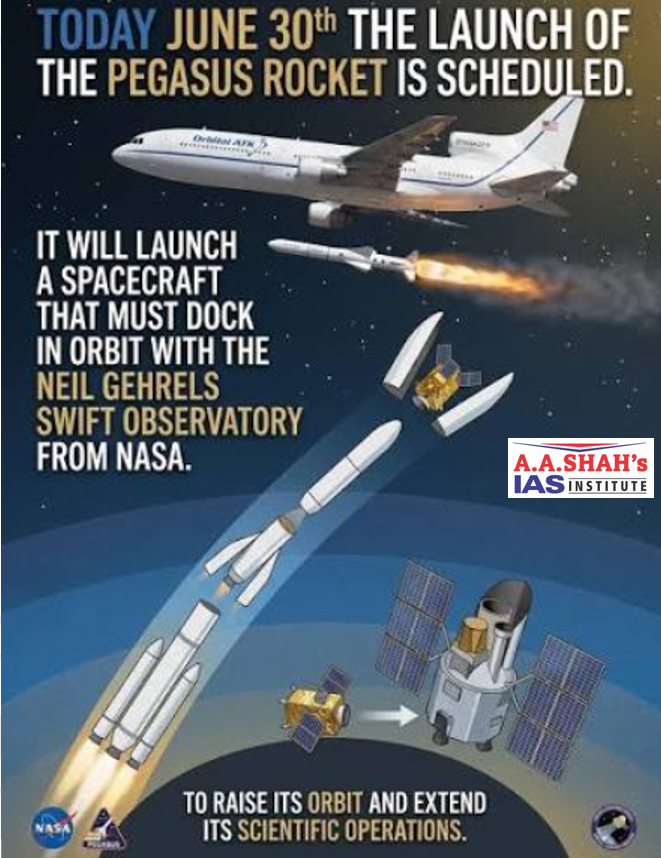
- On June 30, NASA launched a daring robotic rescue mission — a long shot to prevent one of its ageing telescopes, the Swift space telescope, from vanishing into dust.
- The $30-million operation is set to last several months, to rescue the Swift space telescope, which is currently falling towards the earth.
- NASA launched the Neil Gehrels Swift Observatory in 2004, originally for a two-year mission to study gamma-ray bursts.
- The rescue spacecraft developed by the U.S. startup Katalyst, was aboard a small rocket named Pegasus.
- After it reaches an orbit near that of the telescope, the robot must locate Swift, manoeuvre around it, and latch on with three ‘arms’. It will then try to tow Swift into a stable orbit over at least a month.
Pegasus
- Pegasus is an air-launched, small-lift launch vehicle developed by Orbital Sciences Corporation and later built and launched by Northrop Grumman.
- Pegasus is the world’s first privately developed orbital launch vehicle.
- Capable of carrying small payloads of up to 443 kilograms into low Earth orbit, Pegasus first flew in 1990 and last flew in 2021, with one mission planned for 2026.
- It has primarily launched scientific satellites for NASA.
- The vehicle consists of three solid-propellant stages and an optional monopropellant fourth stage.
- Pegasus is released from a carrier aircraft at about 40,000 feet (12,000 m) over open ocean, where it free-falls for five seconds before igniting its first-stage motor.