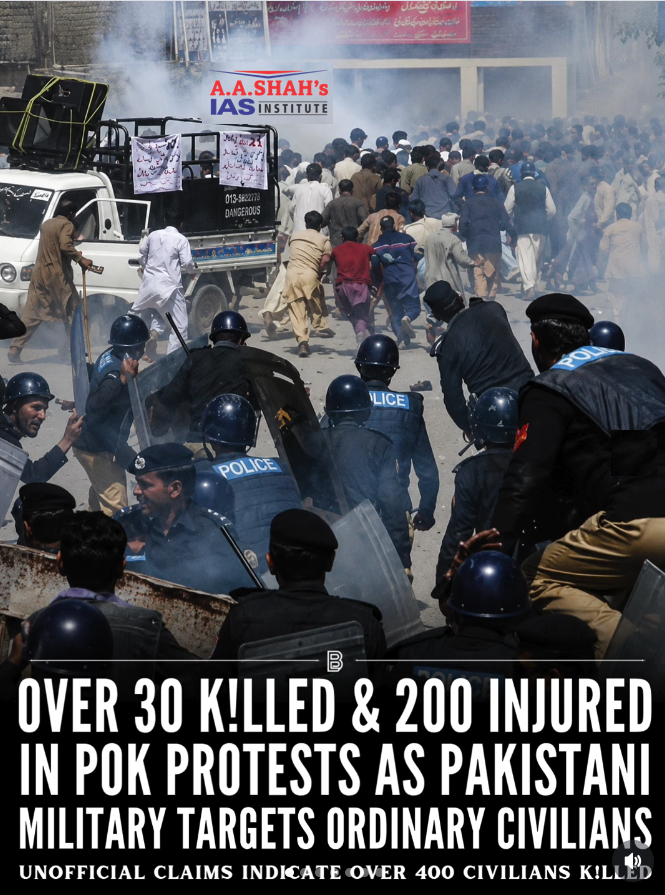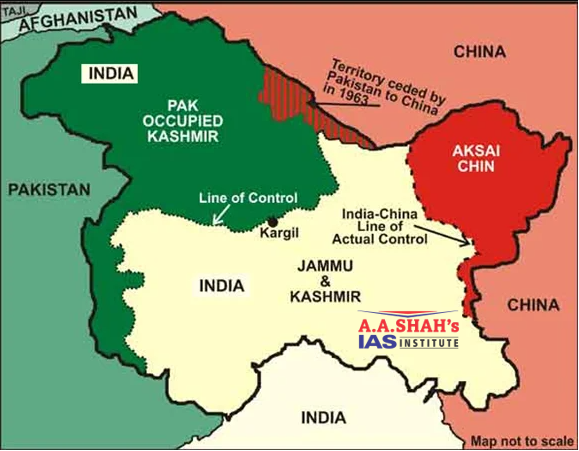
Protests in PoK brutally suppressed by Pakistan
BILATERAL – INDIA-ASIA
14 JUNE 2026
- Pakistan-occupied Kashmir (PoK), which Pakistan calls Azad Jammu and Kashmir, has witnessed repeated protests since 2023 over:
- Rising electricity tariffs
- Inflation and high cost of living
- Demand for subsidised wheat flour
- Greater political representation
- Opposition to 12 reserved refugee seats in the PoK Assembly
- The protests are being led by the Joint Awami Action Committee (JAAC), a coalition of civil society groups, traders, students, and socio-religious organisations.
Joint Awami Action Committee (JAAC
- Formed in 2023 during protests against inflation and electricity prices.
- Issued a 38-point Charter of Demands.
- Key demands:
- Subsidised wheat flour
- Fair electricity pricing based on local hydropower production from the Mangla Dam
- Abolition of 12 reserved refugee seats in the Assembly
Reservation for Refugees
- The 12 seats are reserved for descendants of people who migrated from Jammu & Kashmir to Pakistan during Partition.
- Protesters argue that most refugees now live permanently in Pakistan. They do not experience local governance issues in PoK and their votes carry disproportionate political influence.
- A refugee vote has significantly greater electoral weight than a vote cast by a resident of PoK.
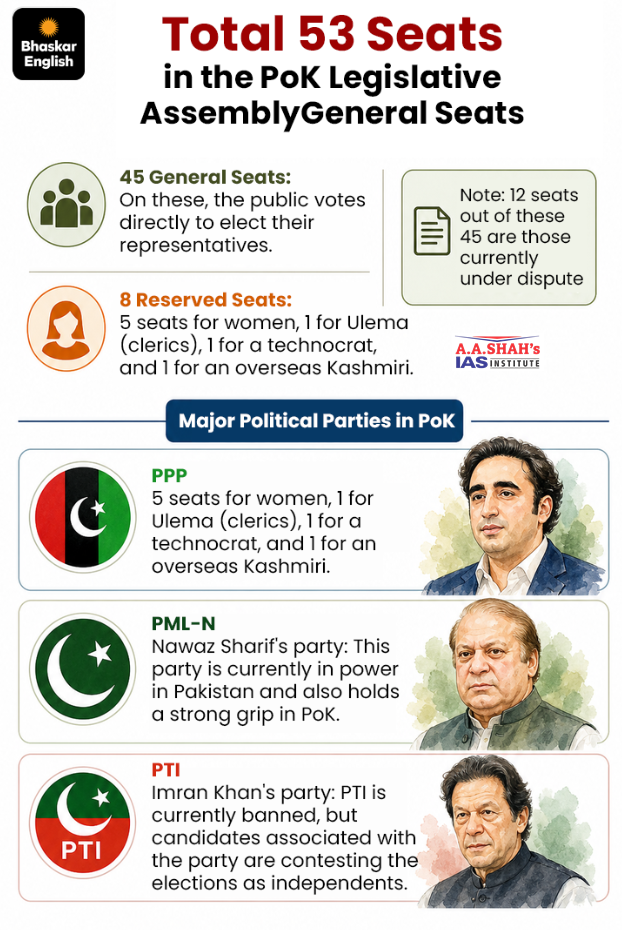
Composition of PoK Assembly
| Category | Seats |
| General elected seats | 33 |
| Refugee seats | 12 |
| Reserved/Nominated seats | 8 |
| Total | 53 |
| Category | Registered Voters |
| Refugee seats (12) | ~4.36 lakh |
| Remaining 33 seats | ~33 lakh |
Why is it politically significant?
- Pakistan officially describes PoK as having self-governance and a right to self-determination.
- However, assembly candidates must sign loyalty oaths supporting accession of Jammu & Kashmir to Pakistan.
- Critics argue this allows Islamabad substantial influence over PoK politics.
- The refugee seats are therefore seen by many protesters as a mechanism through which Pakistan influences regional politics.
Supreme Court Position
- On 7 June 2026, the Supreme Court of PoK issued an advisory opinion in a presidential reference that the 12 refugee seats are constitutionally protected. They cannot be abolished through executive action.
- Only a constitutional amendment can remove them.
- This significantly weakened the protesters’ immediate demand.
Timeline of Protests
May 2024
- JAAC organised a march to Muzaffarabad.
- Around 70 activists were arrested.
- Clashes with police resulted in 4 deaths and hundreds injured
- Pakistan approved an $86.25 million subsidy package.
October 2025
- Talks between JAAC and authorities broke down.
- Fresh protests erupted.
- At least 10 people were killed.
- Government accepted some demands:
- Compensation for victims
- Health card funding
- PKR 10 billion for electricity infrastructure
June 2026
- Elections scheduled for 27 July 2026.
- JAAC announced another protest march demanding abolition of refugee seats.
- Government banned JAAC under anti-terror laws.
- Bounties were announced for some leaders.
- Violent clashes followed in Mirpur, Rawalakot and Muzaffarabad
- More than 30 deaths have been reported.
- Internet restrictions and deployment of paramilitary forces followed.
India’s Reaction
- The Ministry of External Affairs accused Pakistan of police brutality, human rights violations and civilian killings
- Farooq Abdullah also called for a UN investigation into the violence.
- Pakistan rejected India’s criticism and accused India of denying Kashmiris the right to self-determination.
International Response
- Amnesty International criticised the crackdown.
- Nearly 30 British parliamentarians urged the UK government to promote de-escalation and investigate reports of arrests, communication blackouts, and violence.