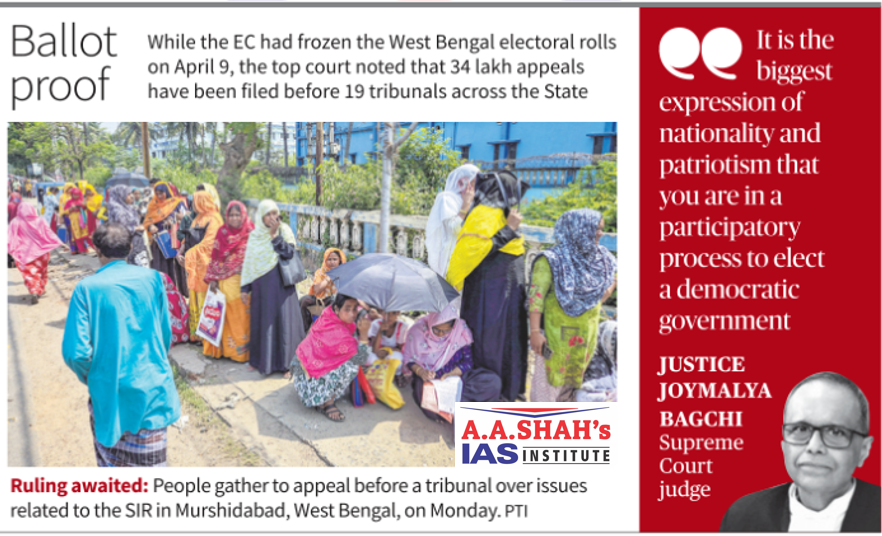
SC tells EC that voting is a sentimental right
POLITY – ELECTIONS
14 APRIL 2026
- The Supreme Court told the Election Commission of India (EC) that the right to be on the electoral roll and to vote in one’s own country is not only constitutional but sentimental.
34 lakh voters excluded from WB
- The top court was referring to lakhs of voters excluded for “logical discrepancies” and lining up for appeal hearings in West Bengal, hardly 10 days ahead of the Assembly election, following an “inquisitorial” special intensive revision (SIR).
- The court said 34 lakh appeals by voters purged from the West Bengal electoral roll have already been filed for hearing before 19 appellate tribunals and there were over a lakh appeals pending before each of these tribunals.
- The poll body had frozen the electoral roll for the State on April 9, 2026; days ahead of the polling on April 23 and 29.
Voting a sentimental right
- “The right to remain on the electoral roll, the right to vote in the country you are born in is something which is not only constitutional but sentimental. It is the biggest expression of nationality and patriotism that you are in a participatory process to elect a democratic government,” Justice Joymalya Bagchi, part of the Bench headed by Chief Justice of India Surya Kant, said while addressing the poll body.
Logical discrepancy criteria
- Senior advocate Dama Seshadri Naidu, for the poll body, said “statistics” proved West Bengal did not “stand out” and was “on par” with other States in the number of exclusions.
- “We are not bothered about West Bengal ‘standing out’. But no other State has a category called ‘logical discrepancy’. We have examined Bihar, we did not find a single person flagged for logical discrepancy… This is not a question of inflating or shrinking the EC, but of fairness,” Justice Bagchi said.
- The judge noted that the court had permitted the poll body to embark on an inquisitorial exercise mindful of the latter’s concern about the electoral rolls.
- “The original SIR notification said voters in the 2002 electoral roll would not be touched. The 2002 roll would be the benchmark. But when you introduced ‘logical discrepancy’, you infracted that rule,” Justice Bagchi told the poll body.
Robust appeal process needed
- Justice Bagchi referred to how the exclusion of voters in the name of logical discrepancy came “so close” to the date of election in West Bengal that the top court had to step in and deploy judicial officers to hear out the objections. This was all the more reason why the appeal process must not be hurried, the judge said.
- The Supreme Court judge said the top court wanted a robust appellate process in place for the excluded voters as the purging of names from the list by the EC was a “suo motu” and unilateral process.
- This was followed by a “verification” of identity documents during the objections phase of the SIR, and not exactly a hearing.
- “The appellate process must be robust… somewhere we are getting blinded by the dust and fury of an impending election… We need to protect the due process rights of the voters,” Justice Bagchi said.